Schema Diagram and Graph Statistics
Since GraphFrames has no support for printing a graph schema, we reuse the one output from Neo4j.
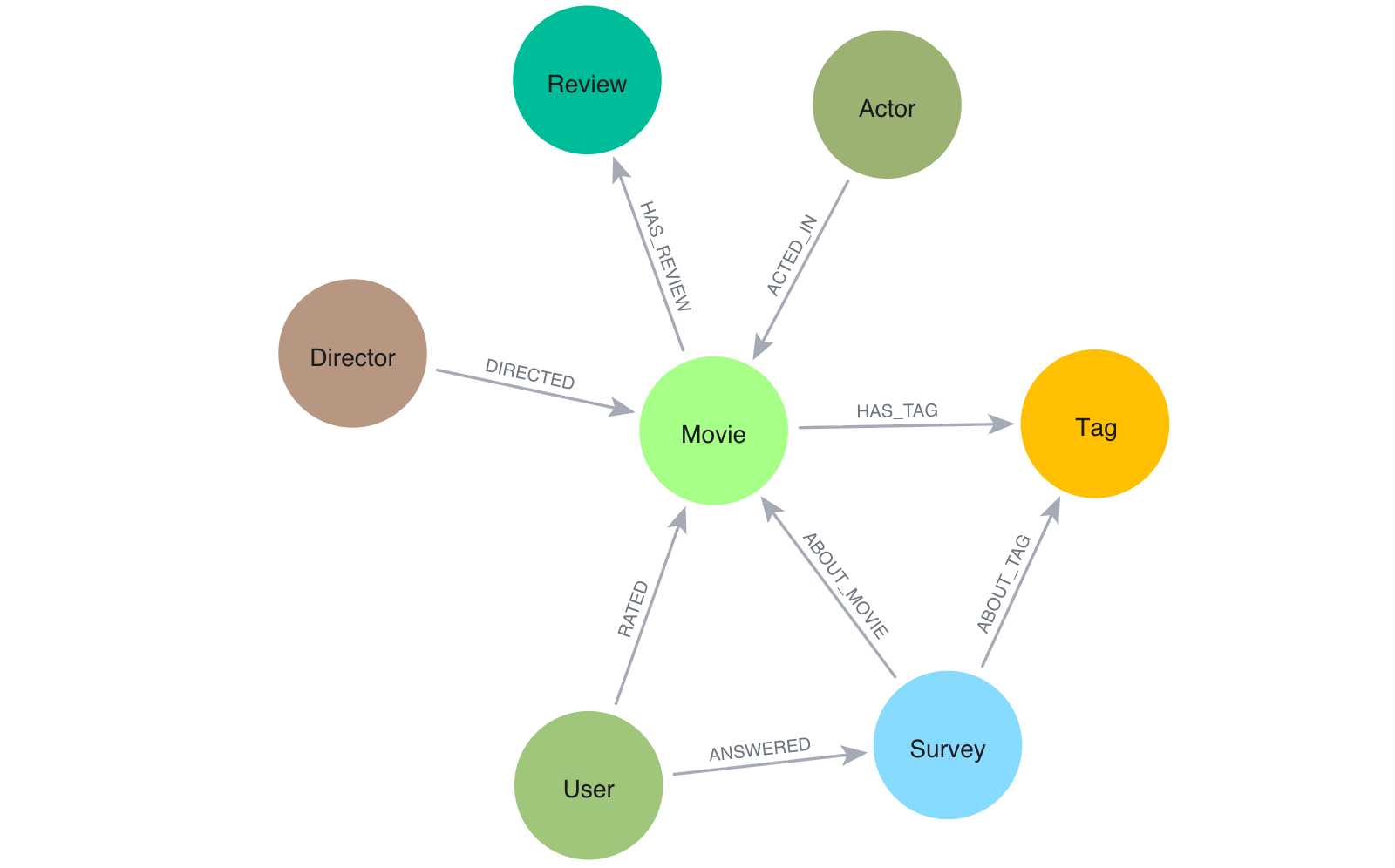
Node Statistics
| Node Label | Count |
|---|---|
| Actor | 122,974 |
| Director | 33,660 |
| Movie | 84,661 |
| Review | 2,623,824 |
| Survey | 58,903 |
| Tag | 1,094 |
| User | 200,948 |
Edge Statistics
| Relationship | Count |
|---|---|
| (:Survey)-[:ABOUT_MOVIE]-(:Movie) | 58,903 |
| (:Survey)-[:ABOUT_TAG]-(:Tag) | 58,903 |
| (:Actor)-[:ACTED_IN]-(:Movie) | 371,629 |
| (:User)-[:ANSWERED]-(:Survey) | 58,903 |
| (:Director)-[:DIRECTED]-(:Movie) | 81,511 |
| (:Movie)-[:HAS_REVIEW]-(:Review) | 2,623,824 |
| (:Movie)-[:HAS_TAG]-(:Tag) | 212,092 |
| (:User)-[:RATED]-(:Movie) | 18,874,784 |
Data Loading
Overview
Data import is handled in three parts. First we upload all the raw data files into DataFrames. Then we define nodes and edges. Finally, we create graph schema.
In order to cope with the formatting in the source file, we defined the following function to read csv files.
DataFrames
We defined a few helper functions to help us process the raw data files.
def read_json_lines(filename, schema):
    return spark.read.option('mode', 'FAILFAST').schema(schema).json(f'{INPUT_ROOT}/{filename}')

def vertex_id(kind, column):
    return F.concat(F.lit(f'{kind}:'), column.cast('string'))

def clean_person_name(column):
    return F.trim(F.regexp_replace(column, r'[\t\r\n]+', ' '))
Define Nodes
First we define the Movie node.
MOVIE_SCHEMA = StructType([
    StructField('item_id', LongType(), False), StructField('title', StringType(), True),
    StructField('directedBy', StringType(), True), StructField('starring', StringType(), True),
    StructField('dateAdded', StringType(), True), StructField('avgRating', DoubleType(), True),
    StructField('imdbId', StringType(), True)])
movie_raw = read_json_lines('metadata.json', MOVIE_SCHEMA)
movie_df = movie_raw.filter(F.col('item_id').isNotNull()).dropDuplicates(['item_id'])
movie_vertices_df = movie_df.select(
    vertex_id('movie', F.col('item_id')).alias('id'), F.lit('movie').alias('type'),
    'item_id', 'title', 'avgRating', 'imdbId', 'directedBy', 'starring')
movie_vertices_df.printSchema(); movie_vertices_df.show(3, truncate=80)
Then we define the Tag node.
TAG_SCHEMA = StructType([StructField('tag', StringType(), True), StructField('id', LongType(), False)])
tag_raw = read_json_lines('tags.json', TAG_SCHEMA)
tag_df = tag_raw.filter(F.col('id').isNotNull()).dropDuplicates(['id'])
tag_vertices_df = tag_df.select(vertex_id('tag', F.col('id')).alias('id'),
    F.lit('tag').alias('type'), F.col('id').alias('tag_id'), 'tag')
tag_vertices_df.printSchema(); tag_vertices_df.show(3, truncate=80)
Then we define the Survey node.
SURVEY_SCHEMA = StructType([
    StructField('item_id', LongType(), False), StructField('score', LongType(), True),
    StructField('tag_id', LongType(), False), StructField('user_id', LongType(), False),
    StructField('survey_id', LongType(), False)])
survey_raw = read_json_lines('surveys_id.json', SURVEY_SCHEMA)
survey_df = (survey_raw.join(F.broadcast(movie_df.select('item_id')), 'item_id', 'inner')
    .join(F.broadcast(tag_df.select(F.col('id').alias('tag_id'))), 'tag_id', 'inner')
    .dropDuplicates(['survey_id']))
survey_vertices_df = survey_df.select(vertex_id('survey', F.col('survey_id')).alias('id'),
    F.lit('survey').alias('type'), 'survey_id', 'user_id', 'item_id', 'tag_id', 'score')
survey_vertices_df.printSchema(); survey_vertices_df.show(3, truncate=80)
Then we define the User node.
USER_SCHEMA = StructType([StructField('user_id', LongType(), False)])
user_rating_raw = read_json_lines('ratings.json', USER_SCHEMA)
user_survey_raw = read_json_lines('surveys_id.json', USER_SCHEMA)
user_raw = user_rating_raw.unionByName(user_survey_raw)
user_df = user_raw.filter(F.col('user_id').isNotNull()).distinct()
user_vertices_df = user_df.select(vertex_id('user', F.col('user_id')).alias('id'),
    F.lit('user').alias('type'), 'user_id')
user_vertices_df.printSchema(); user_vertices_df.show(3, truncate=80)
Then we define the Review node.
REVIEW_SCHEMA = StructType([StructField('item_id', LongType(), False),
    StructField('txt', StringType(), True), StructField('review_id', LongType(), False)])
review_raw = read_json_lines('review_with_id.json', REVIEW_SCHEMA)
review_df = (review_raw.join(F.broadcast(movie_df.select('item_id')), 'item_id', 'inner')
    .dropDuplicates(['review_id']))
review_vertices_df = review_df.select(vertex_id('review', F.col('review_id')).alias('id'),
    F.lit('review').alias('type'), 'review_id', 'item_id', F.col('txt').alias('text'))
review_vertices_df.printSchema(); review_vertices_df.show(3, truncate=80)
Then we define the Director node.
DIRECTOR_SCHEMA = StructType([StructField('item_id', LongType(), False),
    StructField('directedBy', StringType(), True)])
director_raw = read_json_lines('metadata.json', DIRECTOR_SCHEMA)
director_df = (director_raw.filter(F.col('directedBy').isNotNull())
    .select('item_id', F.explode(F.split('directedBy', ',')).alias('raw_name'))
    .select('item_id', clean_person_name(F.col('raw_name')).alias('name'))
    .filter(F.length('name') > 0).dropDuplicates(['item_id', 'name']))
director_vertices_df = (director_df.select('name').distinct()
    .select(vertex_id('director', F.col('name')).alias('id'), F.lit('director').alias('type'), 'name'))
director_vertices_df.printSchema(); director_vertices_df.show(3, truncate=80)
Then we define the Actor node.
ACTOR_SCHEMA = StructType([StructField('item_id', LongType(), False),
    StructField('starring', StringType(), True)])
actor_raw = read_json_lines('metadata.json', ACTOR_SCHEMA)
actor_df = (actor_raw.filter(F.col('starring').isNotNull())
    .select('item_id', F.explode(F.split('starring', ',')).alias('raw_name'))
    .select('item_id', clean_person_name(F.col('raw_name')).alias('name'))
    .filter(F.length('name') > 0).dropDuplicates(['item_id', 'name']))
actor_vertices_df = (actor_df.select('name').distinct()
    .select(vertex_id('actor', F.col('name')).alias('id'), F.lit('actor').alias('type'), 'name'))
actor_vertices_df.printSchema(); actor_vertices_df.show(3, truncate=80)
Define Edges
Next step is to define edges. First we define the RATED edge.
RATED_SCHEMA = StructType([StructField('item_id', LongType(), False),
StructField('user_id', LongType(), False), StructField('rating', DoubleType(), True)])
rated_raw = read_json_lines('ratings.json', RATED_SCHEMA)
rated_df = rated_raw.join(F.broadcast(movie_df.select('item_id')), 'item_id', 'inner')
rated_edges_df = rated_df.select(vertex_id('user', F.col('user_id')).alias('src'),
vertex_id('movie', F.col('item_id')).alias('dst'), F.lit('rated').alias('etype'), 'rating')
rated_edges_df.printSchema(); rated_edges_df.show(3, truncate=80)
Then we define the HAS_TAG edge.
HAS_TAG_SCHEMA = StructType([StructField('item_id', LongType(), False),
    StructField('tag_id', LongType(), False), StructField('num', LongType(), True)])
has_tag_raw = read_json_lines('tag_count.json', HAS_TAG_SCHEMA)
has_tag_df = (has_tag_raw.join(F.broadcast(movie_df.select('item_id')), 'item_id', 'inner')
    .join(F.broadcast(tag_df.select(F.col('id').alias('tag_id'))), 'tag_id', 'inner')
    .dropDuplicates(['item_id', 'tag_id']))
has_tag_edges_df = has_tag_df.select(vertex_id('movie', F.col('item_id')).alias('src'),
    vertex_id('tag', F.col('tag_id')).alias('dst'), F.lit('has_tag').alias('etype'),
    F.col('num').alias('count'))
has_tag_edges_df.printSchema(); has_tag_edges_df.show(3, truncate=80)
Then we define the HAS_REVIEW edge.
HAS_REVIEW_SCHEMA = StructType([StructField('item_id', LongType(), False),
    StructField('review_id', LongType(), False)])
has_review_raw = read_json_lines('review_with_id.json', HAS_REVIEW_SCHEMA)
has_review_df = (has_review_raw.join(F.broadcast(movie_df.select('item_id')), 'item_id', 'inner')
    .dropDuplicates(['review_id']))
has_review_edges_df = has_review_df.select(vertex_id('movie', F.col('item_id')).alias('src'),
    vertex_id('review', F.col('review_id')).alias('dst'), F.lit('has_review').alias('etype'))
has_review_edges_df.printSchema(); has_review_edges_df.show(3, truncate=80)
Then we define the ANSWERED edge.
ANSWERED_SCHEMA = StructType([StructField('survey_id', LongType(), False),
    StructField('user_id', LongType(), False)])
answered_raw = read_json_lines('surveys_id.json', ANSWERED_SCHEMA)
answered_df = answered_raw.join(survey_df.select('survey_id'), 'survey_id', 'inner').dropDuplicates(['survey_id'])
answered_edges_df = answered_df.select(vertex_id('user', F.col('user_id')).alias('src'),
    vertex_id('survey', F.col('survey_id')).alias('dst'), F.lit('answered').alias('etype'))
answered_edges_df.printSchema(); answered_edges_df.show(3, truncate=80)
Then we define the ABOUT_MOVIE edge.
ABOUT_MOVIE_SCHEMA = StructType([StructField('survey_id', LongType(), False),
    StructField('item_id', LongType(), False)])
about_movie_raw = read_json_lines('surveys_id.json', ABOUT_MOVIE_SCHEMA)
about_movie_df = about_movie_raw.join(survey_df.select('survey_id'), 'survey_id', 'inner').dropDuplicates(['survey_id'])
about_movie_edges_df = about_movie_df.select(vertex_id('survey', F.col('survey_id')).alias('src'),
    vertex_id('movie', F.col('item_id')).alias('dst'), F.lit('about_movie').alias('etype'))
about_movie_edges_df.printSchema(); about_movie_edges_df.show(3, truncate=80)
Then we define the ABOUT_TAG edge.
ABOUT_TAG_SCHEMA = StructType([StructField('survey_id', LongType(), False),
    StructField('tag_id', LongType(), False)])
about_tag_raw = read_json_lines('surveys_id.json', ABOUT_TAG_SCHEMA)
about_tag_df = about_tag_raw.join(survey_df.select('survey_id'), 'survey_id', 'inner').dropDuplicates(['survey_id'])
about_tag_edges_df = about_tag_df.select(vertex_id('survey', F.col('survey_id')).alias('src'),
    vertex_id('tag', F.col('tag_id')).alias('dst'), F.lit('about_tag').alias('etype'))
about_tag_edges_df.printSchema(); about_tag_edges_df.show(3, truncate=80)
Then we define the DIRECTED edge.
DIRECTED_SCHEMA = StructType([StructField('item_id', LongType(), False),
    StructField('directedBy', StringType(), True)])
directed_raw = read_json_lines('metadata.json', DIRECTED_SCHEMA)
directed_df = (directed_raw.filter(F.col('directedBy').isNotNull())
    .select('item_id', F.explode(F.split('directedBy', ',')).alias('raw_name'))
    .select('item_id', clean_person_name(F.col('raw_name')).alias('name'))
    .filter(F.length('name') > 0)
    .join(F.broadcast(movie_df.select('item_id')), 'item_id', 'inner')
    .dropDuplicates(['item_id', 'name']))
directed_edges_df = directed_df.select(vertex_id('director', F.col('name')).alias('src'),
    vertex_id('movie', F.col('item_id')).alias('dst'), F.lit('directed').alias('etype'))
directed_edges_df.printSchema(); directed_edges_df.show(3, truncate=80)
Then we define the ACTED_IN edge.
ACTED_IN_SCHEMA = StructType([StructField('item_id', LongType(), False),
    StructField('starring', StringType(), True)])
acted_in_raw = read_json_lines('metadata.json', ACTED_IN_SCHEMA)
acted_in_df = (acted_in_raw.filter(F.col('starring').isNotNull())
    .select('item_id', F.explode(F.split('starring', ',')).alias('raw_name'))
    .select('item_id', clean_person_name(F.col('raw_name')).alias('name'))
    .filter(F.length('name') > 0)
    .join(F.broadcast(movie_df.select('item_id')), 'item_id', 'inner')
    .dropDuplicates(['item_id', 'name']))
acted_in_edges_df = acted_in_df.select(vertex_id('actor', F.col('name')).alias('src'),
    vertex_id('movie', F.col('item_id')).alias('dst'), F.lit('acted_in').alias('etype'))
acted_in_edges_df.printSchema(); acted_in_edges_df.show(3, truncate=80)
Define Graph
Now that we have defined our vertices and edges, we can create graph schema with those. First, we need to union all vertex types into a single vertex dataframe, and all edge types into a single edge dataframe.
vertex_source_dfs = {
    'movie': movie_vertices_df, 'tag': tag_vertices_df, 'survey': survey_vertices_df,
    'user': user_vertices_df, 'review': review_vertices_df,
    'director': director_vertices_df, 'actor': actor_vertices_df}
edge_source_dfs = {
    'rated': rated_edges_df, 'has_tag': has_tag_edges_df, 'has_review': has_review_edges_df,
    'answered': answered_edges_df, 'about_movie': about_movie_edges_df,
    'about_tag': about_tag_edges_df, 'directed': directed_edges_df, 'acted_in': acted_in_edges_df}
Finally, we can create the whole graph schema.
vertices = union_all(list(vertex_source_dfs.values()))
edges = union_all(list(edge_source_dfs.values()))
g = GraphFrame(vertices, edges)
Queries
Select a query below to view its logic and description.
Q1. Movies Rated by a Selected User
This query lists the movies directly connected to a selected user through outgoing RATED edges.
q1_g = GraphFrame(vertices_df, edges_df)

q1_result = (
    q1_g.find('(u)-[r]->(m)')
    .filter(
        (F.col('u.type') == 'user') &
        (F.col('u.user_id') == 997206) &
        (F.col('r.etype') == 'rated') &
        (F.col('m.type') == 'movie')
    )
    .select(
        F.col('m.item_id').alias('MovieID'),
        F.col('m.title').alias('Movie'),
        F.col('r.rating').alias('Rating'),
    )
    .orderBy(F.desc('Rating'))
)

q1_result.show(truncate=False)
Equivalent query in GQL standard:
MATCH (u:mlgenome_user {user_id: 1})-[r:mlgenome_rated]->(m:mlgenome_movie)
RETURN m.item_id AS MovieID, m.title AS Movie, r.rating AS Rating
ORDER BY Rating DESC
LIMIT 20
Q2. Two-Hop Rating Neighborhood of a User
This query finds distinct users reachable within two RATED hops from a selected user through shared movies.
q2_g = GraphFrame(vertices_df, edges_df)

q2_hop1 = (
    q2_g.find('(u)-[e1]-(n)')
    .filter(
        (F.col('u.type') == 'user') &
        (F.col('u.user_id') == 997206) &
        (F.col('e1.etype') == 'rated') &
        (F.col('n.id') != F.col('u.id'))
    )
    .select(
        F.array(F.col('n.type')).alias('NodeLabels'),
        F.coalesce(
            F.col('n.title'),
            F.col('n.user_id').cast('string'),
            F.col('n.id'),
        ).alias('Neighbor'),
        F.lit(1).alias('HopCount'),
    )
)

q2_hop2 = (
    q2_g.find('(u)-[e1]-(v1); (v1)-[e2]-(n)')
    .filter(
        (F.col('u.type') == 'user') &
        (F.col('u.user_id') == 997206) &
        (F.col('e1.etype') == 'rated') &
        (F.col('e2.etype') == 'rated') &
        (F.col('e1._eid') != F.col('e2._eid')) &
        (F.col('n.id') != F.col('u.id'))
    )
    .select(
        F.array(F.col('n.type')).alias('NodeLabels'),
        F.coalesce(
            F.col('n.title'),
            F.col('n.user_id').cast('string'),
            F.col('n.id'),
        ).alias('Neighbor'),
        F.lit(2).alias('HopCount'),
    )
)

q2_result = (
    q2_hop1.unionByName(q2_hop2)
    .dropDuplicates(['NodeLabels', 'Neighbor', 'HopCount'])
    .orderBy('HopCount', 'Neighbor')
)

q2_result.show(truncate=False)
Equivalent query in GQL standard:
MATCH p = (u:mlgenome_user {user_id: 1})-[:mlgenome_rated]-{1,2}(n)
WHERE n != u
RETURN DISTINCT labels(n) AS NodeLabels,
       coalesce(n.title, toString(n.user_id)) AS Neighbor,
       length(p) AS HopCount
ORDER BY HopCount ASC, Neighbor
LIMIT 50
Q3. Users Exactly Two Hops Away Through Shared Movies
This query returns users exactly two RATED hops away from a selected user, meaning users who rated at least one same movie.
q3_g = GraphFrame(vertices_df, edges_df)

q3_result = (
    q3_g.find('(u)-[r1]->(m); (other)-[r2]->(m)')
    .filter(
        (F.col('u.type') == 'user') &
        (F.col('u.user_id') == 997206) &
        (F.col('other.type') == 'user') &
        (F.col('other.id') != F.col('u.id')) &
        (F.col('m.type') == 'movie') &
        (F.col('r1.etype') == 'rated') &
        (F.col('r2.etype') == 'rated')
    )
    .groupBy(F.col('other.user_id').alias('SimilarUser'))
    .agg(F.countDistinct('m.id').alias('SharedMovies'))
    .orderBy(F.desc('SharedMovies'))
)

q3_result.show(truncate=False)
Equivalent query in GQL standard:
MATCH (u:mlgenome_user {user_id: 1})-[:mlgenome_rated]->(m:mlgenome_movie)<-[:mlgenome_rated]-(other:mlgenome_user)
WHERE other != u
RETURN other.user_id AS SimilarUser, count(DISTINCT m) AS SharedMovies
ORDER BY SharedMovies DESC
LIMIT 20
Q4. High-Rated One-Hop Movie Neighborhood
This query searches a selected user's immediate movie neighborhood while filtering on both the RATED edge value and the movie's average rating.
q4_g = GraphFrame(vertices_df, edges_df)

q4_result = (
    q4_g.find('(u)-[r]->(m)')
    .filter(
        (F.col('u.type') == 'user') &
        (F.col('u.user_id') == 997206) &
        (F.col('r.etype') == 'rated') &
        (F.col('m.type') == 'movie') &
        (F.col('r.rating') >= 4.0) &
        (F.col('m.avgRating') >= 4.0)
    )
    .select(
        F.col('m.item_id').alias('MovieID'),
        F.col('m.title').alias('Movie'),
        F.col('r.rating').alias('UserRating'),
        F.col('m.avgRating').alias('AverageRating'),
    )
    .orderBy(F.desc('UserRating'), F.desc('AverageRating'))
)

q4_result.show(truncate=False)
Equivalent query in GQL standard:
MATCH (u:mlgenome_user {user_id: 1})-[r:mlgenome_rated]->(m:mlgenome_movie)
WHERE r.rating >= 4.0 AND m.avgRating >= 4.0
RETURN m.item_id AS MovieID, m.title AS Movie, r.rating AS UserRating, m.avgRating AS AverageRating
ORDER BY UserRating DESC, AverageRating DESC
LIMIT 20
Q5. Users Who Did NOT Participate in Any Survey
This query identifies users who have not participated in any tag genome surveys.
q5_g = GraphFrame(vertices_df, edges_df)

# filterEdges/dropIsolatedVertices obtains the vertices incident to ANSWERED edges.
# subtract is used only for the NOT-EXISTS set difference; GraphFrames has no
# negative-edge motif operator.
q5_answered_graph = q5_g.filterEdges("etype = 'answered'").dropIsolatedVertices()

q5_all_users = q5_g.vertices.filter(F.col('type') == 'user').select('id', 'user_id')
q5_answered_users = (
    q5_answered_graph.vertices
    .filter(F.col('type') == 'user')
    .select('id', 'user_id')
)

q5_result = (
    q5_all_users.subtract(q5_answered_users)
    .select(F.col('user_id').alias('UserID'))
)

q5_result.show(truncate=False)
Equivalent query in GQL standard:
MATCH (u:mlgenome_user)
WHERE NOT (u)-[:mlgenome_answered]->(:mlgenome_survey)
RETURN u.user_id AS UserID
LIMIT 20
Q6. High-Count Movie Tag Edges
This query filters HAS_TAG edges by their count property to find strong movie-tag associations.
q6_g = GraphFrame(vertices_df, edges_df)

q6_result = (
    q6_g.find('(m)-[ht]->(t)')
    .filter(
        (F.col('m.type') == 'movie') &
        (F.col('ht.etype') == 'has_tag') &
        (F.col('t.type') == 'tag') &
        (F.col('ht.count') >= 20)
    )
    .select(
        F.col('m.title').alias('Movie'),
        F.col('t.tag').alias('Tag'),
        F.col('ht.count').alias('TagCount'),
    )
    .orderBy(F.desc('TagCount'))
)

q6_result.show(truncate=False)
Equivalent query in GQL standard:
MATCH (m:mlgenome_movie)-[ht:mlgenome_has_tag]->(t:mlgenome_tag)
WHERE ht.count >= 20
RETURN m.title AS Movie, t.tag AS Tag, ht.count AS TagCount
ORDER BY TagCount DESC
LIMIT 20
Q7. User Reachability to a Tag Through Rated Movies
This query checks whether a selected user can reach a selected tag through movies they rated.
q7_g = GraphFrame(vertices_df, edges_df)

q7_paths = (
    q7_g.find('(u)-[r]->(m); (m)-[ht]->(t)')
    .filter(
        (F.col('u.type') == 'user') &
        (F.col('u.user_id') == 997206) &
        (F.col('r.etype') == 'rated') &
        (F.col('m.type') == 'movie') &
        (F.col('ht.etype') == 'has_tag') &
        (F.col('t.type') == 'tag') &
        (F.col('t.tag_id') == 22)
    )
)

q7_tag = (
    q7_g.vertices
    .filter((F.col('type') == 'tag') & (F.col('tag_id') == 22))
    .select('tag')
    .first()
)
q7_reachable = q7_paths.limit(1).count() > 0

q7_result = spark.createDataFrame(
    [(997206, q7_tag['tag'] if q7_tag else None, q7_reachable)],
    'UserID long, Tag string, Reachable boolean',
)

q7_result.show(truncate=False)
Equivalent query in GQL standard:
MATCH (u:mlgenome_user {user_id: 1})
MATCH (t:mlgenome_tag)
WITH u, t
LIMIT 1
OPTIONAL MATCH p = (u)-[:mlgenome_rated]->(:mlgenome_movie)-[:mlgenome_has_tag]->(t)
RETURN u.user_id AS UserID, t.tag AS Tag, count(p) > 0 AS Reachable
Q8. Shortest User-to-Tag Explanation Path
This query finds the shortest path from a user to a tag over ratings and movie-tag relationships.
q8_g = GraphFrame(vertices_df, edges_df)

q8_bfs = q8_g.bfs(
    fromExpr="type = 'user' AND user_id = 997206",
    toExpr="type = 'tag' AND tag_id = 22",
    edgeFilter="etype IN ('rated', 'has_tag')",
    maxPathLength=4,
)

# With these directed edge types, a successful path is User -> Movie -> Tag.
q8_result = q8_bfs.select(
    F.array(
        F.col('from.user_id').cast('string'),
        F.col('v1.title'),
        F.col('to.tag'),
    ).alias('Path'),
    F.lit(2).alias('Hops'),
)

q8_result.show(truncate=False)
Equivalent query in GQL standard:
MATCH p = SHORTEST (u:mlgenome_user {user_id: 1})-[:mlgenome_rated|mlgenome_has_tag]-{1,4}(t:mlgenome_tag)
RETURN p
Q9. Simple Co-Rating Paths Between Users
This query enumerates simple RATED paths up to four hops between one user and another user in the rating graph.
q9_g = GraphFrame(vertices_df, edges_df)

# Neo4j selects an arbitrary target with LIMIT 1, so this translation intentionally
# keeps the same unspecified target choice. In a User--Movie RATED graph, a
# User-to-User path of length 1..3 can only have length 2.
q9_target = (
    q9_g.vertices
    .filter((F.col('type') == 'user') & (F.col('user_id') != 997206))
    .select('id', 'user_id')
    .first()
)

q9_result = (
    q9_g.find('(source)-[r1]-(m); (m)-[r2]-(target)')
    .filter(
        (F.col('source.type') == 'user') &
        (F.col('source.user_id') == 997206) &
        (F.col('target.id') == q9_target['id']) &
        (F.col('m.type') == 'movie') &
        (F.col('r1.etype') == 'rated') &
        (F.col('r2.etype') == 'rated') &
        (F.col('r1._eid') != F.col('r2._eid'))
    )
    .select(
        F.array(
            F.col('source.user_id').cast('string'),
            F.col('m.title'),
            F.col('target.user_id').cast('string'),
        ).alias('Path'),
        F.lit(2).alias('Hops'),
    )
)

q9_result.show(truncate=False)
Equivalent query in GQL standard:
MATCH p = ACYCLIC (source:mlgenome_user {user_id: 1})-[:mlgenome_rated]-{1,4}(target:mlgenome_user)
WHERE target != source
RETURN p
LIMIT 20
Q10. User-Movie Co-Rating Squares
This query finds two users who both rated the same pair of movies, forming a four-node square in the user-movie rating graph.
q10_g = GraphFrame(vertices_df, edges_df)

q10_result = (
    q10_g.find(
        '(u1)-[r1]->(m1); (u2)-[r2]->(m1); '
        '(u2)-[r3]->(m2); (u1)-[r4]->(m2)'
    )
    .filter(
        (F.col('u1.type') == 'user') &
        (F.col('u2.type') == 'user') &
        (F.col('m1.type') == 'movie') &
        (F.col('m2.type') == 'movie') &
        (F.col('r1.etype') == 'rated') &
        (F.col('r2.etype') == 'rated') &
        (F.col('r3.etype') == 'rated') &
        (F.col('r4.etype') == 'rated') &
        (F.col('u1.user_id') < F.col('u2.user_id')) &
        (F.col('m1.item_id') < F.col('m2.item_id'))
    )
    .select(
        F.col('u1.user_id').alias('User1'),
        F.col('u2.user_id').alias('User2'),
        F.col('m1.title').alias('Movie1'),
        F.col('m2.title').alias('Movie2'),
    )
)

q10_result.show(truncate=False)
Equivalent query in GQL standard:
MATCH (u1:mlgenome_user)-[:mlgenome_rated]->(m1:mlgenome_movie)<-[:mlgenome_rated]-(u2:mlgenome_user)-[:mlgenome_rated]->(m2:mlgenome_movie)<-[:mlgenome_rated]-(u1)
WHERE u1.user_id < u2.user_id AND m1.item_id < m2.item_id
RETURN u1.user_id AS User1, u2.user_id AS User2, m1.title AS Movie1, m2.title AS Movie2
LIMIT 20
Q11. Movie Star Pattern Across Cast, Tags, and Reviews
This query treats each movie as a star center connected to actors, tags, and reviews, then returns the busiest centers.
q11_g = GraphFrame(vertices_df, edges_df)

q11_to_src = F.struct(
    AM.src['type'].alias('receiver_type'),
    AM.src['title'].alias('receiver_title'),
    AM.edge['etype'].alias('etype'),
    AM.dst['id'].alias('neighbor_id'),
)
q11_to_dst = F.struct(
    AM.dst['type'].alias('receiver_type'),
    AM.dst['title'].alias('receiver_title'),
    AM.edge['etype'].alias('etype'),
    AM.src['id'].alias('neighbor_id'),
)

q11_aggregated = q11_g.aggregateMessages(
    [
        F.first(AM.msg['receiver_type'], ignorenulls=True).alias('receiver_type'),
        F.first(AM.msg['receiver_title'], ignorenulls=True).alias('receiver_title'),
        F.countDistinct(
            F.when(AM.msg['etype'] == 'acted_in', AM.msg['neighbor_id'])
        ).alias('ActorCount'),
        F.countDistinct(
            F.when(AM.msg['etype'] == 'has_tag', AM.msg['neighbor_id'])
        ).alias('TagCount'),
        F.countDistinct(
            F.when(AM.msg['etype'] == 'has_review', AM.msg['neighbor_id'])
        ).alias('ReviewCount'),
    ],
    sendToSrc=[q11_to_src],
    sendToDst=[q11_to_dst],
)

q11_result = (
    q11_aggregated
    .filter(
        (F.col('receiver_type') == 'movie') &
        (F.col('ActorCount') >= 2) &
        (F.col('TagCount') >= 2)
    )
    .select(
        F.col('receiver_title').alias('Movie'),
        'ActorCount',
        'TagCount',
        'ReviewCount',
        (F.col('ActorCount') + F.col('TagCount') + F.col('ReviewCount')).alias('StarDegree'),
    )
    .orderBy(F.desc('StarDegree'))
)

q11_result.show(truncate=False)
q11_aggregated.unpersist()
Equivalent query in GQL standard:
MATCH (m:mlgenome_movie)
OPTIONAL MATCH (a:mlgenome_actor)-[:mlgenome_acted_in]->(m)
OPTIONAL MATCH (m)-[:mlgenome_has_tag]->(t:mlgenome_tag)
OPTIONAL MATCH (m)-[:mlgenome_has_review]->(r:mlgenome_review)
WITH m, count(DISTINCT a) AS ActorCount, count(DISTINCT t) AS TagCount, count(DISTINCT r) AS ReviewCount
WHERE ActorCount >= 2 AND TagCount >= 2
RETURN m.title AS Movie, ActorCount, TagCount, ReviewCount, ActorCount + TagCount + ReviewCount AS StarDegree
ORDER BY StarDegree DESC
LIMIT 20
Q12. Four-Actor Co-Starring Cliques
This query finds four actors who co-star in the same movie, representing a four-clique in the projected co-actor graph.
q12_g = GraphFrame(vertices_df, edges_df)

q12_result = (
    q12_g.find(
        '(a1)-[e1]->(m); (a2)-[e2]->(m); '
        '(a3)-[e3]->(m); (a4)-[e4]->(m)'
    )
    .filter(
        (F.col('a1.type') == 'actor') &
        (F.col('a2.type') == 'actor') &
        (F.col('a3.type') == 'actor') &
        (F.col('a4.type') == 'actor') &
        (F.col('m.type') == 'movie') &
        (F.col('e1.etype') == 'acted_in') &
        (F.col('e2.etype') == 'acted_in') &
        (F.col('e3.etype') == 'acted_in') &
        (F.col('e4.etype') == 'acted_in') &
        (F.col('a1.name') < F.col('a2.name')) &
        (F.col('a2.name') < F.col('a3.name')) &
        (F.col('a3.name') < F.col('a4.name'))
    )
    .select(
        F.col('m.title').alias('Movie'),
        F.col('a1.name').alias('Actor1'),
        F.col('a2.name').alias('Actor2'),
        F.col('a3.name').alias('Actor3'),
        F.col('a4.name').alias('Actor4'),
    )
)

q12_result.show(truncate=False)
Equivalent query in GQL standard:
MATCH (a1:mlgenome_actor)-[:mlgenome_acted_in]->(m:mlgenome_movie)<-[:mlgenome_acted_in]-(a2:mlgenome_actor),
      (a3:mlgenome_actor)-[:mlgenome_acted_in]->(m)<-[:mlgenome_acted_in]-(a4:mlgenome_actor)
WHERE a1.name < a2.name AND a2.name < a3.name AND a3.name < a4.name
RETURN m.title AS Movie, a1.name AS Actor1, a2.name AS Actor2, a3.name AS Actor3, a4.name AS Actor4
LIMIT 20
Q13. Most Similar Users Based on Ratings for the Same Movies (Find pairs of users with overlapping movie preferences. (Collaborative filtering foundation))
This query finds pairs of users who have rated the same movies similarly (within a difference of 1 rating point) and share at least 5 such movie preferences.
q13_g = GraphFrame(vertices_df, edges_df)

q13_result = (
    q13_g.find('(u1)-[r1]->(m); (u2)-[r2]->(m)')
    .filter(
        (F.col('u1.type') == 'user') &
        (F.col('u2.type') == 'user') &
        (F.col('u1.id') != F.col('u2.id')) &
        (F.col('m.type') == 'movie') &
        (F.col('r1.etype') == 'rated') &
        (F.col('r2.etype') == 'rated') &
        (F.abs(F.col('r1.rating') - F.col('r2.rating')) <= 1)
    )
    .groupBy(
        F.col('u1.user_id').alias('User1'),
        F.col('u2.user_id').alias('User2'),
    )
    .agg(F.countDistinct('m.id').alias('SharedMovies'))
    .filter(F.col('SharedMovies') >= 5)
    .orderBy(F.desc('SharedMovies'))
)

q13_result.show(truncate=False)
Equivalent query in GQL standard:
MATCH (u1:mlgenome_user)-[r1:mlgenome_rated]->(m:mlgenome_movie)<-[r2:mlgenome_rated]-(u2:mlgenome_user)
WHERE u1 != u2 AND abs(r1.rating - r2.rating) <= 1
WITH u1.user_id AS User1, u2.user_id AS User2, count(m) AS SharedMovies
WHERE SharedMovies >= 5
RETURN User1, User2, SharedMovies
ORDER BY SharedMovies DESC
LIMIT 10
Q14. User-Survey-Movie-Tag Line Pattern
This query follows a four-node line from users to surveys, then to movies, and finally to tags attached to those movies.
q14_g = GraphFrame(vertices_df, edges_df)

q14_result = (
    q14_g.find('(u)-[a]->(s); (s)-[am]->(m); (m)-[ht]->(t)')
    .filter(
        (F.col('u.type') == 'user') &
        (F.col('a.etype') == 'answered') &
        (F.col('s.type') == 'survey') &
        (F.col('am.etype') == 'about_movie') &
        (F.col('m.type') == 'movie') &
        (F.col('ht.etype') == 'has_tag') &
        (F.col('t.type') == 'tag')
    )
    .select(
        F.col('u.user_id').alias('UserID'),
        F.col('s.survey_id').alias('SurveyID'),
        F.col('m.title').alias('Movie'),
        F.col('t.tag').alias('Tag'),
        F.col('s.score').alias('SurveyScore'),
    )
)

q14_result.show(truncate=False)
Equivalent query in GQL standard:
MATCH (u:mlgenome_user)-[:mlgenome_answered]->(s:mlgenome_survey)-[:mlgenome_about_movie]->(m:mlgenome_movie)-[:mlgenome_has_tag]->(t:mlgenome_tag)
RETURN u.user_id AS UserID, s.survey_id AS SurveyID, m.title AS Movie, t.tag AS Tag, s.score AS SurveyScore
LIMIT 20
Q15. Movie Degree Summary Across All Relationship Types
This query computes ungrouped degree statistics for Movie nodes across their adjacent relationships.
q15_g = GraphFrame(vertices_df, edges_df)

q15_to_src = F.struct(
    AM.src['type'].alias('receiver_type'),
    AM.dst['id'].alias('neighbor_id'),
)
q15_to_dst = F.struct(
    AM.dst['type'].alias('receiver_type'),
    AM.src['id'].alias('neighbor_id'),
)

q15_aggregated = q15_g.aggregateMessages(
    [
        F.first(AM.msg['receiver_type'], ignorenulls=True).alias('receiver_type'),
        F.countDistinct(AM.msg['neighbor_id']).alias('Degree'),
    ],
    sendToSrc=[q15_to_src],
    sendToDst=[q15_to_dst],
)

q15_nonisolated_movie_degrees = (
    q15_aggregated
    .filter(F.col('receiver_type') == 'movie')
    .select('Degree')
)

# GraphFrames has no negative motif. Use its isolated-vertex operation plus
# set subtraction to add Degree=0 movies without a table join.
q15_connected_movie_ids = (
    q15_g.dropIsolatedVertices().vertices
    .filter(F.col('type') == 'movie')
    .select('id')
)
q15_isolated_movie_degrees = (
    q15_g.vertices
    .filter(F.col('type') == 'movie')
    .select('id')
    .subtract(q15_connected_movie_ids)
    .select(F.lit(0).cast('long').alias('Degree'))
)
q15_movie_degrees = q15_nonisolated_movie_degrees.unionByName(
    q15_isolated_movie_degrees
)

q15_result = q15_movie_degrees.agg(
    F.count(F.lit(1)).alias('MovieCount'),
    F.round(F.avg('Degree'), 2).alias('AvgDegree'),
    F.min('Degree').alias('MinDegree'),
    F.max('Degree').alias('MaxDegree'),
)

q15_result.show(truncate=False)
q15_aggregated.unpersist()
Equivalent query in GQL standard:
MATCH (m:mlgenome_movie)
OPTIONAL MATCH (m)-[]-(n)
WITH m, count(DISTINCT n) AS Degree
RETURN count(m) AS MovieCount,
       round(avg(Degree), 2) AS AvgDegree,
       min(Degree) AS MinDegree,
       max(Degree) AS MaxDegree
Q16. Directors by Average Movie Rating (Filtering to avoid bias from 1-hit wonders, so considering movies >= 3)
This query computes the average rating and movie count for each director with at least 3 movies, sorting them to find the top 10 highest-rated directors.
q16_g = GraphFrame(vertices_df, edges_df)

q16_result = (
    q16_g.find('(d)-[e]->(m)')
    .filter(
        (F.col('d.type') == 'director') &
        (F.col('e.etype') == 'directed') &
        (F.col('m.type') == 'movie') &
        F.col('m.avgRating').isNotNull()
    )
    .groupBy(F.col('d.name').alias('Director'))
    .agg(
        F.round(F.avg('m.avgRating'), 2).alias('AvgRating'),
        F.count('m.id').alias('Movies'),
    )
    .filter(F.col('Movies') >= 3)
    .orderBy(F.desc('AvgRating'))
)

q16_result.show(truncate=False)
Equivalent query in GQL standard:
MATCH (d:mlgenome_director)-[:mlgenome_directed]->(m:mlgenome_movie)
WHERE m.avgRating IS NOT NULL
WITH d.name AS Director, avg(m.avgRating) AS AvgRating, count(m) AS Movies
WHERE Movies >= 3
RETURN Director, round(AvgRating, 2) AS AvgRating, Movies
ORDER BY AvgRating DESC
LIMIT 10
Q17. Actors by Number of Movies Acted In
This query calculates the total number of movies each actor has starred in and returns the top 10 most prolific actors.
q17_g = GraphFrame(vertices_df, edges_df)

q17_result = (
    q17_g.find('(a)-[e]->(m)')
    .filter(
        (F.col('a.type') == 'actor') &
        (F.col('e.etype') == 'acted_in') &
        (F.col('m.type') == 'movie')
    )
    .groupBy(F.col('a.name').alias('Actor'))
    .agg(F.count('m.id').alias('TotalMovies'))
    .orderBy(F.desc('TotalMovies'))
)

q17_result.show(truncate=False)
Equivalent query in GQL standard:
MATCH (a:mlgenome_actor)-[:mlgenome_acted_in]->(m:mlgenome_movie)
RETURN a.name AS Actor, count(m) AS TotalMovies
ORDER BY TotalMovies DESC
LIMIT 10
Q18. Rating Edge Summary
This query summarizes all RATED edges by count and rating-value statistics.
q18_g = GraphFrame(vertices_df, edges_df)

q18_result = (
    q18_g.find('(u)-[r]->(m)')
    .filter(
        (F.col('u.type') == 'user') &
        (F.col('r.etype') == 'rated') &
        (F.col('m.type') == 'movie')
    )
    .agg(
        F.count(F.lit(1)).alias('RatingCount'),
        F.round(F.avg('r.rating'), 2).alias('AvgRating'),
        F.min('r.rating').alias('MinRating'),
        F.max('r.rating').alias('MaxRating'),
    )
)

q18_result.show(truncate=False)
Equivalent query in GQL standard:
MATCH (:mlgenome_user)-[r:mlgenome_rated]->(:mlgenome_movie)
RETURN count(r) AS RatingCount,
       round(avg(r.rating), 2) AS AvgRating,
       min(r.rating) AS MinRating,
       max(r.rating) AS MaxRating
Q19. Users Who Rate Harshly (Lowest Average Rating)
This query identifies the top 10 users with the lowest average ratings among those who have submitted at least 5 ratings, highlighting the harshest critics.
q19_g = GraphFrame(vertices_df, edges_df)

q19_result = (
    q19_g.find('(u)-[r]->(m)')
    .filter(
        (F.col('u.type') == 'user') &
        (F.col('r.etype') == 'rated') &
        (F.col('m.type') == 'movie')
    )
    .filter(F.col('r.rating').isNotNull())
    .groupBy(F.col('u.user_id').alias('UserID'))
    .agg(
        F.count(F.lit(1)).alias('TotalRatings'),
        F.round(F.avg('r.rating'), 2).alias('AvgRating'),
    )
    .filter(F.col('TotalRatings') >= 5)
    .select('UserID', 'AvgRating', 'TotalRatings')
    .orderBy('AvgRating')
)

q19_result.show(truncate=False)
Equivalent query in GQL standard:
MATCH (u:mlgenome_user)-[r:mlgenome_rated]->(m:mlgenome_movie)
WHERE r.rating IS NOT NULL
WITH u.user_id AS UserID, count(r) AS TotalRatings, avg(r.rating) AS AvgRating
WHERE TotalRatings >= 5
RETURN UserID, round(AvgRating, 2) AS AvgRating, TotalRatings
ORDER BY AvgRating ASC
LIMIT 10
Q20. Bounded Rating Path Counts by Length
This query counts bounded RATED paths from a selected user and groups the result only by path length.
q20_g = GraphFrame(vertices_df, edges_df)

q20_h1 = (
    q20_g.find('(u)-[e1]-(n)')
    .filter(
        (F.col('u.type') == 'user') &
        (F.col('u.user_id') == 997206) &
        (F.col('e1.etype') == 'rated')
    )
    .agg(
        F.count(F.lit(1)).alias('PathCount'),
        F.countDistinct('n.id').alias('DistinctTargets'),
    )
    .withColumn('PathLength', F.lit(1))
)

q20_h2 = (
    q20_g.find('(u)-[e1]-(v1); (v1)-[e2]-(n)')
    .filter(
        (F.col('u.type') == 'user') &
        (F.col('u.user_id') == 997206) &
        (F.col('e1.etype') == 'rated') &
        (F.col('e2.etype') == 'rated') &
        (F.col('e1._eid') != F.col('e2._eid'))
    )
    .agg(
        F.count(F.lit(1)).alias('PathCount'),
        F.countDistinct('n.id').alias('DistinctTargets'),
    )
    .withColumn('PathLength', F.lit(2))
)

q20_h3 = (
    q20_g.find('(u)-[e1]-(v1); (v1)-[e2]-(v2); (v2)-[e3]-(n)')
    .filter(
        (F.col('u.type') == 'user') &
        (F.col('u.user_id') == 997206) &
        (F.col('e1.etype') == 'rated') &
        (F.col('e2.etype') == 'rated') &
        (F.col('e3.etype') == 'rated') &
        (F.col('e1._eid') != F.col('e2._eid')) &
        (F.col('e1._eid') != F.col('e3._eid')) &
        (F.col('e2._eid') != F.col('e3._eid'))
    )
    .agg(
        F.count(F.lit(1)).alias('PathCount'),
        F.countDistinct('n.id').alias('DistinctTargets'),
    )
    .withColumn('PathLength', F.lit(3))
)

q20_result = (
    q20_h1.unionByName(q20_h2).unionByName(q20_h3)
    .select('PathLength', 'PathCount', 'DistinctTargets')
    .orderBy('PathLength')
)

q20_result.show(truncate=False)
Equivalent query in GQL standard:
MATCH p = (:mlgenome_user {user_id: 1})-[:mlgenome_rated]-{1,3}(target)
RETURN length(p) AS PathLength,
       count(p) AS PathCount,
       count(DISTINCT target) AS DistinctTargets
ORDER BY PathLength ASC
Q21. Bounded Rating Path Counts by Length and Endpoint Type
This query extends path-count aggregation by grouping bounded paths by both path length and endpoint label.
q21_g = GraphFrame(vertices_df, edges_df)

q21_h1 = (
    q21_g.find('(u)-[e1]-(n)')
    .filter(
        (F.col('u.type') == 'user') &
        (F.col('u.user_id') == 997206) &
        (F.col('e1.etype') == 'rated')
    )
    .groupBy(F.col('n.type').alias('EndpointType'))
    .agg(
        F.count(F.lit(1)).alias('PathCount'),
        F.countDistinct('n.id').alias('DistinctTargets'),
    )
    .withColumn('PathLength', F.lit(1))
)

q21_h2 = (
    q21_g.find('(u)-[e1]-(v1); (v1)-[e2]-(n)')
    .filter(
        (F.col('u.type') == 'user') &
        (F.col('u.user_id') == 997206) &
        (F.col('e1.etype') == 'rated') &
        (F.col('e2.etype') == 'rated') &
        (F.col('e1._eid') != F.col('e2._eid'))
    )
    .groupBy(F.col('n.type').alias('EndpointType'))
    .agg(
        F.count(F.lit(1)).alias('PathCount'),
        F.countDistinct('n.id').alias('DistinctTargets'),
    )
    .withColumn('PathLength', F.lit(2))
)

q21_h3 = (
    q21_g.find('(u)-[e1]-(v1); (v1)-[e2]-(v2); (v2)-[e3]-(n)')
    .filter(
        (F.col('u.type') == 'user') &
        (F.col('u.user_id') == 997206) &
        (F.col('e1.etype') == 'rated') &
        (F.col('e2.etype') == 'rated') &
        (F.col('e3.etype') == 'rated') &
        (F.col('e1._eid') != F.col('e2._eid')) &
        (F.col('e1._eid') != F.col('e3._eid')) &
        (F.col('e2._eid') != F.col('e3._eid'))
    )
    .groupBy(F.col('n.type').alias('EndpointType'))
    .agg(
        F.count(F.lit(1)).alias('PathCount'),
        F.countDistinct('n.id').alias('DistinctTargets'),
    )
    .withColumn('PathLength', F.lit(3))
)

q21_result = (
    q21_h1.unionByName(q21_h2).unionByName(q21_h3)
    .select('PathLength', 'EndpointType', 'PathCount', 'DistinctTargets')
    .orderBy('PathLength', F.desc('PathCount'))
)

q21_result.show(truncate=False)
Equivalent query in GQL standard:
MATCH p = (:mlgenome_user {user_id: 1})-[:mlgenome_rated]-{1,3}(target)
WITH length(p) AS PathLength, labels(target)[0] AS EndpointType, target, p
RETURN PathLength,
       EndpointType,
       count(p) AS PathCount,
       count(DISTINCT target) AS DistinctTargets
ORDER BY PathLength ASC, PathCount DESC
Q22. Directors with the Most Movies Above 4.0 Rating (Not just average, how many great movies have they made? Considered minimum of 2 movies)
This query finds the top 10 directors with the most movies rated 4.0 or above, considering only directors who have at least 2 such highly-rated movies.
q22_g = GraphFrame(vertices_df, edges_df)

q22_result = (
    q22_g.find('(d)-[e]->(m)')
    .filter(
        (F.col('d.type') == 'director') &
        (F.col('e.etype') == 'directed') &
        (F.col('m.type') == 'movie') &
        (F.col('m.avgRating') >= 4.0)
    )
    .groupBy(F.col('d.name').alias('Director'))
    .agg(F.count('m.id').alias('HighRatedMovies'))
    .filter(F.col('HighRatedMovies') >= 2)
    .orderBy(F.desc('HighRatedMovies'))
)

q22_result.show(truncate=False)
Equivalent query in GQL standard:
MATCH (d:mlgenome_director)-[:mlgenome_directed]->(m:mlgenome_movie)
WHERE m.avgRating >= 4.0
WITH d.name AS Director, count(m) AS HighRatedMovies
WHERE HighRatedMovies >= 2
RETURN Director, HighRatedMovies
ORDER BY HighRatedMovies DESC
LIMIT 10
Q23. Top Tags by Frequency in Surveys (Which tags are evaluated most often by users?)
This query counts the total number of survey evaluations for each tag and returns the top 10 most frequently evaluated tags.
q23_g = GraphFrame(vertices_df, edges_df)

q23_result = (
    q23_g.find('(s)-[e]->(t)')
    .filter(
        (F.col('s.type') == 'survey') &
        (F.col('e.etype') == 'about_tag') &
        (F.col('t.type') == 'tag')
    )
    .groupBy(F.col('t.tag').alias('Tag'))
    .agg(F.count(F.lit(1)).alias('SurveyCount'))
    .orderBy(F.desc('SurveyCount'))
)

q23_result.show(truncate=False)
Equivalent query in GQL standard:
MATCH (:mlgenome_survey)-[:mlgenome_about_tag]->(t:mlgenome_tag)
RETURN t.tag AS Tag, count(*) AS SurveyCount
ORDER BY SurveyCount DESC
LIMIT 10
Q24. Tags Most Frequently Scored Highly in Surveys (Which tags do users consistently agree are applicable to movies (score ≥ 4)?)
This query identifies tags that users consistently score highly (survey score >= 4) and returns the top 10 highest-scoring tags.
q24_g = GraphFrame(vertices_df, edges_df)

q24_result = (
    q24_g.find('(s)-[e]->(t)')
    .filter(
        (F.col('s.type') == 'survey') &
        (F.col('s.score') >= 4) &
        (F.col('e.etype') == 'about_tag') &
        (F.col('t.type') == 'tag')
    )
    .groupBy(F.col('t.tag').alias('Tag'))
    .agg(F.count(F.lit(1)).alias('HighScoreCount'))
    .orderBy(F.desc('HighScoreCount'))
)

q24_result.show(truncate=False)
Equivalent query in GQL standard:
MATCH (s:mlgenome_survey)-[:mlgenome_about_tag]->(t:mlgenome_tag)
WHERE s.score >= 4
RETURN t.tag AS Tag, count(*) AS HighScoreCount
ORDER BY HighScoreCount DESC
LIMIT 10
Q25. Movies With Most Tagged Survey Feedback (Which movies have been analyzed most often in surveys?)
This query finds the top 10 movies that have been evaluated the most number of times in tag genome surveys.
q25_g = GraphFrame(vertices_df, edges_df)

q25_result = (
    q25_g.find('(s)-[e]->(m)')
    .filter(
        (F.col('s.type') == 'survey') &
        (F.col('e.etype') == 'about_movie') &
        (F.col('m.type') == 'movie')
    )
    .groupBy(F.col('m.title').alias('Movie'))
    .agg(F.count(F.lit(1)).alias('SurveyMentions'))
    .orderBy(F.desc('SurveyMentions'))
)

q25_result.show(truncate=False)
Equivalent query in GQL standard:
MATCH (s:mlgenome_survey)-[:mlgenome_about_movie]->(m:mlgenome_movie)
RETURN m.title AS Movie, count(*) AS SurveyMentions
ORDER BY SurveyMentions DESC
LIMIT 10
Q26. Users Who Participated in the Most Surveys
This query lists the top 10 users who have participated in the highest number of tag genome surveys.
q26_g = GraphFrame(vertices_df, edges_df)

q26_result = (
    q26_g.find('(u)-[e]->(s)')
    .filter(
        (F.col('u.type') == 'user') &
        (F.col('e.etype') == 'answered') &
        (F.col('s.type') == 'survey')
    )
    .groupBy(F.col('u.user_id').alias('User'))
    .agg(F.count('s.id').alias('TotalSurveys'))
    .orderBy(F.desc('TotalSurveys'))
)

q26_result.show(truncate=False)
Equivalent query in GQL standard:
MATCH (u:mlgenome_user)-[:mlgenome_answered]->(s:mlgenome_survey)
RETURN u.user_id AS User, count(s) AS TotalSurveys
ORDER BY TotalSurveys DESC
LIMIT 10
Q27. PageRank on the MovieLens Genome Rating Graph
This query runs PageRank over an undirected User-Movie rating graph projection and returns the highest-scoring nodes.
q27_g = GraphFrame(vertices_df, edges_df)

q27_rating_graph = GraphFrame(
    q27_g.vertices.filter(F.col('type').isin('user', 'movie')),
    q27_g.edges.filter(F.col('etype') == 'rated'),
).as_undirected()

q27_pagerank = q27_rating_graph.pageRank(
    resetProbability=0.15,
    maxIter=20,
)

q27_result = (
    q27_pagerank.vertices
    .select(
        F.array(F.col('type')).alias('Labels'),
        F.coalesce(
            F.col('user_id').cast('string'),
            F.col('title'),
            F.col('id'),
        ).alias('Node'),
        F.col('pagerank').alias('Score'),
    )
    .orderBy(F.desc('Score'))
)

q27_result.show(truncate=False)
Q28. Weakly Connected Components of the Rating Graph
This query finds weakly connected components in the undirected User-Movie rating graph projection.
q28_g = GraphFrame(vertices_df, edges_df)

q28_rating_graph = GraphFrame(
    q28_g.vertices.filter(F.col('type').isin('user', 'movie')),
    q28_g.edges.filter(F.col('etype') == 'rated'),
).as_undirected()

q28_components = q28_rating_graph.connectedComponents(
    algorithm='graphframes',
    broadcastThreshold=-1,
    use_local_checkpoints=True,
)

q28_result = (
    q28_components
    .groupBy(F.col('component').alias('componentId'))
    .agg(F.count(F.lit(1)).alias('ComponentSize'))
    .orderBy(F.desc('ComponentSize'))
)

q28_result.show(truncate=False)
q28_components.unpersist()
Q29. Strongly Connected Components of Directed Rating Edges
This query treats RATED edges as directed from users to movies and reports strongly connected component sizes.
Q30. Louvain Communities in the Rating Graph
This query detects communities in the undirected User-Movie rating graph using Louvain and returns the largest communities.
q30_g = GraphFrame(vertices_df, edges_df)

q30_rating_graph = GraphFrame(
    q30_g.vertices.filter(F.col('type').isin('user', 'movie')),
    q30_g.edges.filter(F.col('etype') == 'rated'),
).as_undirected()

q30_communities = q30_rating_graph.labelPropagation(
    maxIter=10,
    algorithm='graphx',
)

q30_result = (
    q30_communities
    .groupBy(F.col('label').alias('communityId'))
    .agg(F.count(F.lit(1)).alias('CommunitySize'))
    .orderBy(F.desc('CommunitySize'))
)

q30_result.show(truncate=False)
q30_communities.unpersist()
Q31. Best Tags per Movie by Survey and Tag_Count
This query correlates tags applied to movies via direct tag counts with survey evaluations to find movie-tag pairings with the highest average consensus score.
q31_g = GraphFrame(vertices_df, edges_df)

q31_result = (
    q31_g.find('(s)-[am]->(m); (s)-[at]->(t); (m)-[ht]->(t)')
    .filter(
        (F.col('s.type') == 'survey') &
        (F.col('am.etype') == 'about_movie') &
        (F.col('m.type') == 'movie') &
        (F.col('at.etype') == 'about_tag') &
        (F.col('t.type') == 'tag') &
        (F.col('ht.etype') == 'has_tag')
    )
    .groupBy(
        F.col('m.title').alias('Movie'),
        F.col('t.tag').alias('Tag'),
    )
    .agg(
        F.sum('ht.count').alias('TagApplications'),
        F.avg('s.score').alias('AvgSurveyScore'),
        F.count('s.id').alias('SurveyMentions'),
    )
    .filter(
        (F.col('TagApplications') > 5) &
        (F.col('SurveyMentions') >= 5)
    )
    .select(
        'Movie',
        'Tag',
        'TagApplications',
        F.round('AvgSurveyScore', 2).alias('AvgSurveyScore'),
        'SurveyMentions',
    )
    .orderBy(F.desc('AvgSurveyScore'), F.desc('SurveyMentions'))
)

q31_result.show(truncate=False)
Equivalent query in GQL standard:
MATCH (m:mlgenome_movie)-[ht:mlgenome_has_tag]->(t:mlgenome_tag)
MATCH (s:mlgenome_survey)-[:mlgenome_about_movie]->(m)
MATCH (s)-[:mlgenome_about_tag]->(t)
WITH m.title AS Movie, t.tag AS Tag,
    sum(ht.count) AS TagApplications,
    avg(s.score) AS AvgSurveyScore,
    count(s) AS SurveyMentions
WHERE TagApplications > 5 AND SurveyMentions >= 5
RETURN Movie, Tag, TagApplications, round(AvgSurveyScore, 2) AS AvgSurveyScore, SurveyMentions
ORDER BY AvgSurveyScore DESC, SurveyMentions DESC
LIMIT 20
Q32. Top Actor-Director Pairs by Number of Collaborations
This query finds the top 10 actor-director pairs with the highest number of movie collaborations.
q32_g = GraphFrame(vertices_df, edges_df)

q32_result = (
    q32_g.find('(d)-[de]->(m); (a)-[ae]->(m)')
    .filter(
        (F.col('d.type') == 'director') &
        (F.col('de.etype') == 'directed') &
        (F.col('m.type') == 'movie') &
        (F.col('a.type') == 'actor') &
        (F.col('ae.etype') == 'acted_in')
    )
    .groupBy(
        F.col('d.name').alias('Director'),
        F.col('a.name').alias('Actor'),
    )
    .agg(F.count('m.id').alias('Collaborations'))
    .orderBy(F.desc('Collaborations'))
)

q32_result.show(truncate=False)
Equivalent query in GQL standard:
MATCH (d:mlgenome_director)-[:mlgenome_directed]->(m:mlgenome_movie)<-[:mlgenome_acted_in]-(a:mlgenome_actor)
RETURN d.name AS Director, a.name AS Actor, count(m) AS Collaborations
ORDER BY Collaborations DESC
LIMIT 10
Q33. Directors Whose Movies Collect the Most Reviews
This query finds the top 10 directors whose movies have collectively accumulated the highest number of text reviews.
q33_g = GraphFrame(vertices_df, edges_df)

q33_result = (
    q33_g.find('(d)-[de]->(m); (m)-[hr]->(review)')
    .filter(
        (F.col('d.type') == 'director') &
        (F.col('de.etype') == 'directed') &
        (F.col('m.type') == 'movie') &
        (F.col('hr.etype') == 'has_review') &
        (F.col('review.type') == 'review')
    )
    .groupBy(F.col('d.name').alias('Director'))
    .agg(F.count('review.id').alias('TotalReviews'))
    .orderBy(F.desc('TotalReviews'))
)

q33_result.show(truncate=False)
Equivalent query in GQL standard:
MATCH (d:mlgenome_director)-[:mlgenome_directed]->(m:mlgenome_movie)-[:mlgenome_has_review]->(r:mlgenome_review)
RETURN d.name AS Director, count(r) AS TotalReviews
ORDER BY TotalReviews DESC
LIMIT 10
Q34. Actor-Director Collaboration Quality (Which pairs consistently produce great movies?)
This query evaluates the quality of actor-director collaborations by computing the average rating of their shared movies, returning the top 10 pairs with at least 3 collaborations.
q34_g = GraphFrame(vertices_df, edges_df)

q34_result = (
    q34_g.find('(d)-[de]->(m); (a)-[ae]->(m)')
    .filter(
        (F.col('d.type') == 'director') &
        (F.col('de.etype') == 'directed') &
        (F.col('m.type') == 'movie') &
        F.col('m.avgRating').isNotNull() &
        (F.col('a.type') == 'actor') &
        (F.col('ae.etype') == 'acted_in')
    )
    .groupBy(
        F.col('d.name').alias('Director'),
        F.col('a.name').alias('Actor'),
    )
    .agg(
        F.count('m.id').alias('Collabs'),
        F.round(F.avg('m.avgRating'), 2).alias('AvgRating'),
    )
    .filter(F.col('Collabs') >= 3)
    .orderBy(F.desc('AvgRating'))
)

q34_result.show(truncate=False)
Equivalent query in GQL standard:
MATCH (d:mlgenome_director)-[:mlgenome_directed]->(m:mlgenome_movie)<-[:mlgenome_acted_in]-(a:mlgenome_actor)
WHERE m.avgRating IS NOT NULL
WITH d.name AS Director, a.name AS Actor, count(m) AS Collabs, avg(m.avgRating) AS AvgRating
WHERE Collabs >= 3
RETURN Director, Actor, Collabs, round(AvgRating, 2) AS AvgRating
ORDER BY AvgRating DESC
LIMIT 10
Q35. Tag-Movie Associations with High Confidence (Which movie-tag pairs were most confidently agreed upon by users?)
This query finds movie-tag pairs that are strongly agreed upon by users, based on the frequency of high survey scores (score >= 4).
q35_g = GraphFrame(vertices_df, edges_df)

q35_result = (
    q35_g.find('(s)-[am]->(m); (s)-[at]->(t)')
    .filter(
        (F.col('s.type') == 'survey') &
        (F.col('s.score') >= 4) &
        (F.col('am.etype') == 'about_movie') &
        (F.col('m.type') == 'movie') &
        (F.col('at.etype') == 'about_tag') &
        (F.col('t.type') == 'tag')
    )
    .groupBy(
        F.col('m.title').alias('Movie'),
        F.col('t.tag').alias('Tag'),
    )
    .agg(F.count(F.lit(1)).alias('HighScoreCount'))
    .orderBy(F.desc('HighScoreCount'))
)

q35_result.show(truncate=False)
Equivalent query in GQL standard:
MATCH (s:mlgenome_survey)-[:mlgenome_about_movie]->(m:mlgenome_movie), (s)-[:mlgenome_about_tag]->(t:mlgenome_tag)
WHERE s.score >= 4
RETURN m.title AS Movie, t.tag AS Tag, count(*) AS HighScoreCount
ORDER BY HighScoreCount DESC
LIMIT 10
Q36. Actors Frequently Appearing in High-Rated Movies with Different Directors (Highlights high-performing, collaborative actors trusted by many top directors.)
This query finds actors who frequently appear in highly-rated movies (rating >= 4.0) with different directors, showcasing versatile and collaborative actors.
q36_g = GraphFrame(vertices_df, edges_df)

q36_result = (
    q36_g.find('(a)-[ae]->(m); (d)-[de]->(m)')
    .filter(
        (F.col('a.type') == 'actor') &
        (F.col('ae.etype') == 'acted_in') &
        (F.col('m.type') == 'movie') &
        (F.col('m.avgRating') >= 4.0) &
        (F.col('d.type') == 'director') &
        (F.col('de.etype') == 'directed')
    )
    .groupBy(F.col('a.name').alias('Actor'))
    .agg(
        F.countDistinct('d.name').alias('UniqueTopDirectors'),
        F.countDistinct('m.id').alias('TopRatedMovies'),
    )
    .filter(F.col('TopRatedMovies') >= 3)
    .orderBy(F.desc('UniqueTopDirectors'), F.desc('TopRatedMovies'))
)

q36_result.show(truncate=False)
Equivalent query in GQL standard:
MATCH (a:mlgenome_actor)-[:mlgenome_acted_in]->(m:mlgenome_movie)<-[:mlgenome_directed]-(d:mlgenome_director)
WHERE m.avgRating >= 4.0
WITH a.name AS Actor, count(DISTINCT d.name) AS UniqueTopDirectors, count(DISTINCT m) AS TopRatedMovies
WHERE TopRatedMovies >= 3
RETURN Actor, UniqueTopDirectors, TopRatedMovies
ORDER BY UniqueTopDirectors DESC, TopRatedMovies DESC
LIMIT 10
Q37. Most Frequently Used Words in Reviews
This query tokenizes text reviews to extract the most frequently used words, filtering out common stop words.
q37_g = GraphFrame(vertices_df, edges_df)

q37_stop_words = [
    'this', 'that', 'with', 'from', 'have', 'your', 'just', 'what', 'when',
    'they', 'were', 'then', 'there', 'would', 'which', 'could', 'really',
]

q37_result = (
    q37_g.vertices
    .filter((F.col('type') == 'review') & F.col('text').isNotNull())
    .select(F.explode(F.split(F.lower('text'), r'\W+')).alias('word'))
    .filter((F.length('word') > 3) & ~F.col('word').isin(q37_stop_words))
    .groupBy('word')
    .agg(F.count(F.lit(1)).alias('freq'))
    .orderBy(F.desc('freq'))
    .limit(20)
)

q37_result.show(20, truncate=False)
split) and no list-unnesting clause
(UNWIND) with which to expand the words of a review into rows.
Q38. Movies Most Frequently Called "Boring", "Disgusting", etc.
This query counts reviews containing negative keywords (e.g., 'boring', 'disgusting', 'waste') for each movie to identify those with the most negative feedback.
q38_g = GraphFrame(vertices_df, edges_df)

q38_result = (
    q38_g.find('(m)-[hr]->(r)')
    .filter(
        (F.col('m.type') == 'movie') &
        (F.col('hr.etype') == 'has_review') &
        (F.col('r.type') == 'review') &
        (
            F.lower(F.col('r.text')).contains('boring') |
            F.lower(F.col('r.text')).contains('disgusting') |
            F.lower(F.col('r.text')).contains('waste') |
            F.lower(F.col('r.text')).contains('terrible') |
            F.lower(F.col('r.text')).contains('bad')
        )
    )
    .groupBy(F.col('m.title').alias('Movie'))
    .agg(F.count(F.lit(1)).alias('NegativeMentions'))
    .orderBy(F.desc('NegativeMentions'))
)

q38_result.show(truncate=False)
Equivalent query in GQL standard:
MATCH (m:mlgenome_movie)-[:mlgenome_has_review]->(r:mlgenome_review)
WHERE toLower(r.text) CONTAINS 'boring'
OR toLower(r.text) CONTAINS 'disgusting'
OR toLower(r.text) CONTAINS 'waste'
OR toLower(r.text) CONTAINS 'terrible'
OR toLower(r.text) CONTAINS 'bad'
WITH m.title AS Movie, count(*) AS NegativeMentions
RETURN Movie, NegativeMentions
ORDER BY NegativeMentions DESC
LIMIT 10
Q39. Users With Highest Survey Agreement Accuracy (Measures users whose survey scores closely align with consensus (like those who gave 5 when others did too))
This query ranks users by how closely their survey ratings align with the consensus ratings for each tag, highlighting the most consistent/accurate survey responders.
q39_g = GraphFrame(vertices_df, edges_df)

q39_consensus = (
    q39_g.find('(u)-[ans]->(s); (s)-[at1]->(t); (s2)-[at2]->(t)')
    .filter(
        (F.col('u.type') == 'user') &
        (F.col('ans.etype') == 'answered') &
        (F.col('s.type') == 'survey') &
        (F.col('at1.etype') == 'about_tag') &
        (F.col('t.type') == 'tag') &
        (F.col('s2.type') == 'survey') &
        (F.col('at2.etype') == 'about_tag') &
        F.col('s2.score').isNotNull()
    )
    .groupBy(
        F.col('u.user_id').alias('User'),
        F.col('t.tag').alias('Tag'),
        F.col('s.score').alias('UserScore'),
    )
    .agg(F.avg('s2.score').alias('Consensus'))
)

q39_result = (
    q39_consensus
    .groupBy('User')
    .agg(
        F.avg(F.abs(F.col('UserScore') - F.col('Consensus'))).alias('AvgDeviation'),
        F.count(F.lit(1)).alias('Count'),
    )
    .filter(F.col('Count') >= 10)
    .select(
        'User',
        F.round('AvgDeviation', 2).alias('AvgTagDisagreement'),
        'Count',
    )
    .orderBy('AvgTagDisagreement')
)

q39_result.show(truncate=False)
Equivalent query in GQL standard:
MATCH (u:mlgenome_user)-[:mlgenome_answered]->(s:mlgenome_survey)-[:mlgenome_about_tag]->(t:mlgenome_tag)
WITH u.user_id AS User, t.tag AS Tag, s.score AS UserScore
MATCH (s2:mlgenome_survey)-[:mlgenome_about_tag]->(t)
WHERE s2.score IS NOT NULL
WITH User, Tag, UserScore, avg(s2.score) AS Consensus
WITH User, avg(abs(UserScore - Consensus)) AS AvgDeviation, count(*) AS Count
WHERE Count >= 10
RETURN User, round(AvgDeviation, 2) AS AvgTagDisagreement, Count
ORDER BY AvgTagDisagreement ASC
LIMIT 10