Schema Diagram and Graph Statistics
Since GraphFrames has no support for printing a graph schema, we reuse the one output from Neo4j.
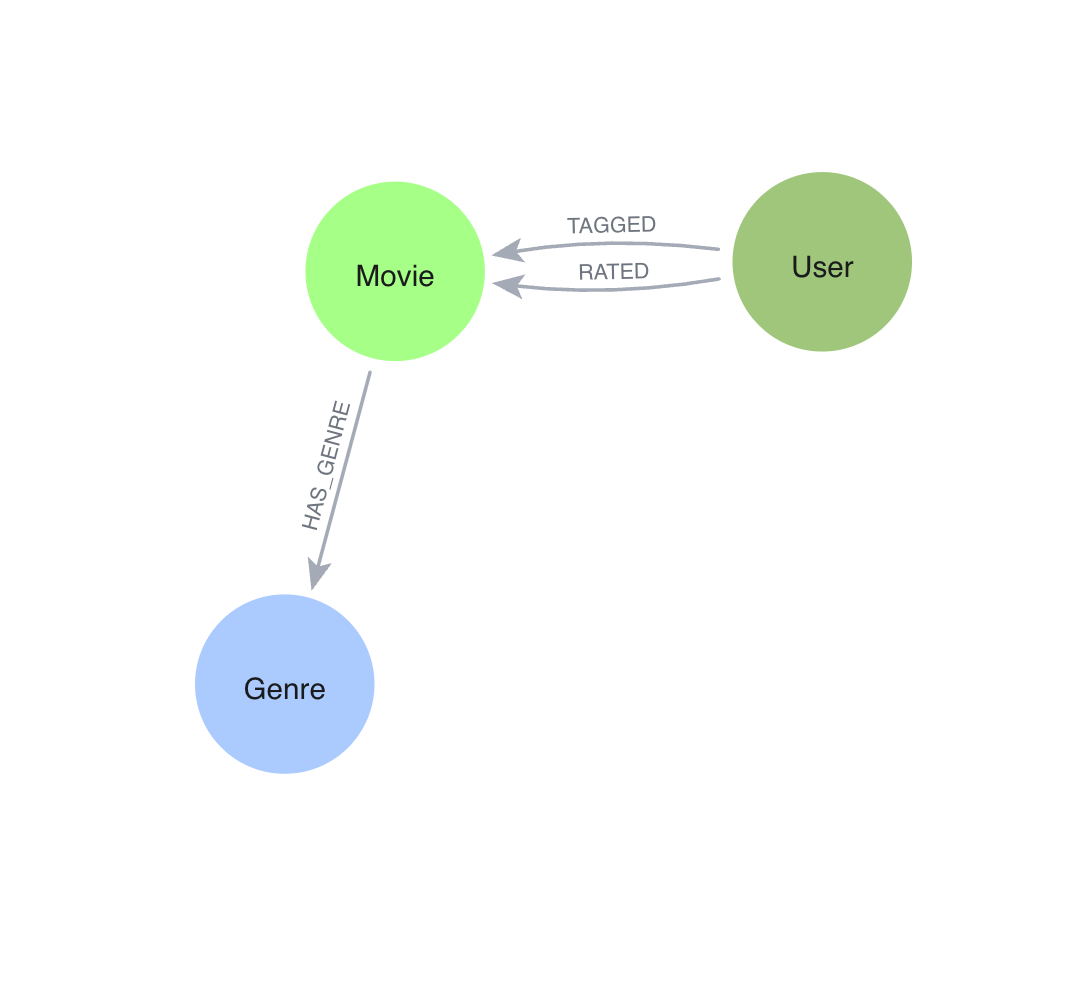
Node Statistics
| Node Label | Count |
|---|---|
| Genre | 20 |
| Movie | 87,585 |
| User | 200,948 |
Edge Statistics
| Relationship | Count |
|---|---|
| (:Movie)-[:HAS_GENRE]-(:Genre) | 154,170 |
| (:User)-[:RATED]-(:Movie) | 32,000,204 |
| (:User)-[:TAGGED]-(:Movie) | 2,000,072 |
Data Loading
Overview
Data import is handled in three parts. First we upload all the raw data files into DataFrames. Then we define nodes and edges. Finally, we create graph schema.
In order to cope with the formatting in the source file, we defined the following function to read csv files.
def read_csv(filename, schema):
    return (spark.read.format("csv").option("header", "true")
        .option("quote", '"').option("escape", '"').option("mode", "FAILFAST")
        .schema(schema).load(f"{INPUT_DIR.rstrip('/')}/{filename}"))
Movie Nodes
The first thing we do would be to load each CSV file into a DataFrame. We start with the Movie nodes.
MOVIE_SCHEMA = StructType([
    StructField("movieId", IntegerType(), False),
    StructField("title", StringType(), False),
    StructField("genres", StringType(), True),
])
movie_raw = read_csv("movies.csv", MOVIE_SCHEMA)
movie = (movie_raw
    .where(F.col("movieId").isNotNull() & F.col("title").isNotNull())
    .dropDuplicates(["movieId"]))
movie_vertices_df = movie.select(
    F.concat(F.lit("m_"), F.col("movieId").cast("string")).alias("id"),
    F.col("movieId"), F.col("title"))
Genre Nodes
Then we start with the Genre nodes. It is derived from the Movie nodes.
genre = (movie.where(F.col("genres").isNotNull())
    .withColumn("name", F.explode(F.split(F.col("genres"), r"\|")))
    .withColumn("name", F.trim(F.col("name")))
    .where(F.col("name").isNotNull() & (F.col("name") != ""))
    .select("movieId", "name").dropDuplicates(["movieId", "name"]))
genre_vertices_df = genre.select("name").distinct().select(
    F.concat(F.lit("g_"), F.col("name")).alias("id"), F.col("name"))
HAS_GENRE Edges
Next we create the DataFrame for HAS_GENRE edges. It can be derived from Genre nodes and Movie nodes.
has_genre_edges_df = genre.select(
    F.concat(F.lit("m_"), F.col("movieId").cast("string")).alias("src"),
    F.concat(F.lit("g_"), F.col("name")).alias("dst"))
RATED Edges
Next we create the DataFrame for RATED edges. We create an edge label before finishing all node lables because the User nodes can be constructed from the RATED dataframe.
RATED_SCHEMA = StructType([
    StructField("userId", IntegerType(), False),
    StructField("movieId", IntegerType(), False),
    StructField("rating", DoubleType(), False),
    StructField("timestamp", LongType(), False),
])
rated_raw = read_csv("ratings.csv", RATED_SCHEMA)
rated = rated_raw.where(
    F.col("userId").isNotNull() & F.col("movieId").isNotNull()
    & F.col("rating").isNotNull() & F.col("timestamp").isNotNull())
rated_edges_df = rated.select(
    F.concat(F.lit("u_"), F.col("userId").cast("string")).alias("src"),
    F.concat(F.lit("m_"), F.col("movieId").cast("string")).alias("dst"),
    F.col("rating"), F.timestamp_seconds(F.col("timestamp")).alias("timestamp"))
User Nodes
Then we start with the User nodes.
user = rated.select("userId").union(tagged.select("userId")).distinct()
user_vertices_df = user.select(
    F.concat(F.lit("u_"), F.col("userId").cast("string")).alias("id"),
    F.col("userId"))
TAGGED Edges
Next we create the DataFrame for TAGGED edges.
TAGGED_SCHEMA = StructType([
    StructField("userId", IntegerType(), False),
    StructField("movieId", IntegerType(), False),
    StructField("tag", StringType(), False),
    StructField("timestamp", LongType(), False),
])
tagged_raw = read_csv("tags.csv", TAGGED_SCHEMA)
tagged = tagged_raw.where(
    F.col("userId").isNotNull() & F.col("movieId").isNotNull()
    & F.col("tag").isNotNull() & (F.trim(F.col("tag")) != "")
    & F.col("timestamp").isNotNull())
tagged_edges_df = tagged.select(
    F.concat(F.lit("u_"), F.col("userId").cast("string")).alias("src"),
    F.concat(F.lit("m_"), F.col("movieId").cast("string")).alias("dst"),
    F.col("tag"), F.timestamp_seconds(F.col("timestamp")).alias("timestamp"))
Define Graph
Now that we have defined our vertices and edges, we can create graph schema with those. First, we need to union all vertex types into a single vertex dataframe, and all edge types into a single edge dataframe.
First we define the following two functions to union all node and edge DataFrames:
def build_vertices(movie_df, user_df, genre_df):
    return (movie_df.withColumn("type", F.lit("Movie"))
        .unionByName(user_df.withColumn("type", F.lit("User")), allowMissingColumns=True)
        .unionByName(genre_df.withColumn("type", F.lit("Genre")), allowMissingColumns=True)
        .select("id", "type", "movieId", "userId", "title", "name"))

def build_edges(rated_df, tagged_df, has_genre_df):
    return (rated_df.withColumn("relationship", F.lit("RATED"))
        .unionByName(tagged_df.withColumn("relationship", F.lit("TAGGED")), allowMissingColumns=True)
        .unionByName(has_genre_df.withColumn("relationship", F.lit("HAS_GENRE")), allowMissingColumns=True)
        .select("src", "dst", "relationship", "rating", "tag", "timestamp"))
from graphframes import GraphFrame

vertices_df = build_vertices(movie_vertices_df, user_vertices_df, genre_vertices_df)
edges_df = build_edges(rated_edges_df, tagged_edges_df, has_genre_edges_df)
g_preview = GraphFrame(vertices_df, edges_df)
Queries
Select a query below to view its logic and description.
Q1. Movies Rated by a User
This query lists the movies directly connected to a selected user by outgoing RATED relationships.
q01_vertices = (spark.table("ml32m.ml32m_user").withColumn("type", F.lit("User"))
    .unionByName(spark.table("ml32m.ml32m_movie").withColumn("type", F.lit("Movie")), allowMissingColumns=True))
q01_edges = spark.table("ml32m.ml32m_rated").withColumn("relationship", F.lit("RATED"))
q01_graph = GraphFrame(q01_vertices, q01_edges)
q01_result = (q01_graph.find("(u)-[r]->(m)")
    .filter((F.col("u.type") == "User") & (F.col("u.userId") == 33) & (F.col("m.type") == "Movie"))
    .select(F.col("m.movieId").alias("movieId"), F.col("m.title").alias("title"),
            F.col("r.rating").alias("rating"), F.col("r.timestamp").alias("ratingTime"))
    .orderBy(F.desc("rating"), F.asc("title")))
q01_result.show(20, truncate=False)
Equivalent query in GQL standard:
MATCH (u:ml32m_user {userId: $userId})-[r:ml32m_rated]->(m:ml32m_movie)
RETURN m.movieId AS movieId, m.title AS title, r.rating AS rating, r.timestamp AS ratingTime
ORDER BY rating DESC, title
LIMIT $limit;
Q2. Genres within Two Hops of a User
This query follows a selected user to rated movies and then to their genres, returning distinct genres within two hops.
q02_vertices = (spark.table("ml32m.ml32m_user").withColumn("type", F.lit("User"))
    .unionByName(spark.table("ml32m.ml32m_movie").withColumn("type", F.lit("Movie")), allowMissingColumns=True)
    .unionByName(spark.table("ml32m.ml32m_genre").withColumn("type", F.lit("Genre")), allowMissingColumns=True))
q02_edges = (spark.table("ml32m.ml32m_rated").withColumn("relationship", F.lit("RATED"))
    .unionByName(spark.table("ml32m.ml32m_has_genre").withColumn("relationship", F.lit("HAS_GENRE")), allowMissingColumns=True))
q02_graph = GraphFrame(q02_vertices, q02_edges)
q02_result = (q02_graph.find("(u)-[r]->(m); (m)-[hg]->(g)")
    .filter((F.col("u.userId") == 33) & (F.col("r.relationship") == "RATED") & (F.col("hg.relationship") == "HAS_GENRE"))
    .select(F.col("g.name").alias("genre")).distinct().orderBy("genre"))
q02_result.show(20, truncate=False)
Equivalent query in GQL standard:
MATCH (:ml32m_user {userId: $userId})-[:ml32m_rated]->(:ml32m_movie)-[:ml32m_has_genre]->(g:ml32m_genre)
RETURN DISTINCT g.name AS genre
ORDER BY genre
LIMIT $limit;
Q3. Users Exactly Two Rating Hops Away
This query finds users exactly two RATED hops away through movies co-rated with a selected user.
q03_vertices = (spark.table("ml32m.ml32m_user").withColumn("type", F.lit("User"))
    .unionByName(spark.table("ml32m.ml32m_movie").withColumn("type", F.lit("Movie")), allowMissingColumns=True))
q03_graph = GraphFrame(q03_vertices, spark.table("ml32m.ml32m_rated"))
q03_result = (q03_graph.find("(u)-[r1]->(m); (other)-[r2]->(m)")
    .filter((F.col("u.userId") == 33) & (F.col("other.userId") != 33))
    .select(F.col("other.userId").alias("userId")).distinct().orderBy("userId"))
q03_result.show(20, truncate=False)
Equivalent query in GQL standard:
MATCH (:ml32m_user {userId: $userId})-[:ml32m_rated]->(:ml32m_movie)<-[:ml32m_rated]-(other:ml32m_user)
WHERE other.userId <> $userId
RETURN DISTINCT other.userId AS userId
ORDER BY userId
LIMIT $limit;
Q4. Highly Rated One-Hop Movies
This query filters a selected user's one-hop movie neighborhood to movies with ratings at or above a threshold.
q04_vertices = (spark.table("ml32m.ml32m_user").withColumn("type", F.lit("User"))
    .unionByName(spark.table("ml32m.ml32m_movie").withColumn("type", F.lit("Movie")), allowMissingColumns=True))
q04_graph = GraphFrame(q04_vertices, spark.table("ml32m.ml32m_rated"))
q04_result = (q04_graph.find("(u)-[r]->(m)")
    .filter((F.col("u.userId") == 33) & (F.col("r.rating") >= 4.0))
    .select(F.col("m.movieId").alias("movieId"), F.col("m.title").alias("title"), F.col("r.rating").alias("rating"))
    .orderBy(F.desc("rating"), F.asc("title")))
q04_result.show(20, truncate=False)
Equivalent query in GQL standard:
MATCH (u:ml32m_user {userId: $userId})-[r:ml32m_rated]->(m:ml32m_movie)
WHERE r.rating >= $minRating
RETURN m.movieId AS movieId, m.title AS title, r.rating AS rating
ORDER BY rating DESC, title
LIMIT $limit;
Q5. Filter Movies by Title Text
This query filters Movie nodes by title text and movie ID without traversing relationships.
q05_result = (spark.table("ml32m.ml32m_movie")
    .filter(F.col("title").contains("Love") & (F.col("movieId") >= 99))
    .select("movieId", "title").orderBy("movieId"))
q05_result.show(20, truncate=False)
Equivalent query in GQL standard:
MATCH (m:ml32m_movie)
WHERE m.title CONTAINS $titleText
  AND m.movieId >= $minMovieId
RETURN m.movieId AS movieId, m.title AS title
ORDER BY m.movieId
LIMIT $limit;
Q6. Filter High-Rating Edges
This query filters RATED relationships by numeric rating and returns their endpoint user and movie.
q06_vertices = (spark.table("ml32m.ml32m_user").withColumn("type", F.lit("User"))
    .unionByName(spark.table("ml32m.ml32m_movie").withColumn("type", F.lit("Movie")), allowMissingColumns=True))
q06_graph = GraphFrame(q06_vertices, spark.table("ml32m.ml32m_rated"))
q06_result = (q06_graph.find("(u)-[r]->(m)").filter(F.col("r.rating") >= 4.0)
    .select(F.col("u.userId").alias("userId"), F.col("m.movieId").alias("movieId"),
            F.col("m.title").alias("title"), F.col("r.rating").alias("rating"))
    .orderBy(F.desc("rating")))
q06_result.show(20, truncate=False)
Equivalent query in GQL standard:
MATCH (u:ml32m_user)-[r:ml32m_rated]->(m:ml32m_movie)
WHERE r.rating >= $minRating
RETURN u.userId AS userId, m.movieId AS movieId, m.title AS title, r.rating AS rating
ORDER BY rating DESC
LIMIT $limit;
Q7. Check Whether a User Can Reach a Movie
This query tests whether a selected user can reach a selected movie within three undirected RATED hops.
q07_vertices = (spark.table("ml32m.ml32m_user").unionByName(
    spark.table("ml32m.ml32m_movie"), allowMissingColumns=True))
q07_graph = GraphFrame(q07_vertices, spark.table("ml32m.ml32m_rated")).as_undirected()
q07_paths = q07_graph.bfs("id = 'u_33'", "id = 'm_66'", maxPathLength=3)
q07_result = spark.createDataFrame([(q07_paths.limit(1).count() > 0,)], ["reachable"])
q07_result.show(truncate=False)
Equivalent query in GQL standard:
MATCH p = ANY (:ml32m_user {userId: $userId})-[:ml32m_rated]-{1,3}(:ml32m_movie {movieId: $movieId})
RETURN true AS reachable;
Q8. Shortest Co-Rating Path to a Movie
This query finds the shortest undirected RATED path between a selected user and movie.
q08_vertices = (spark.table("ml32m.ml32m_user").unionByName(
    spark.table("ml32m.ml32m_movie"), allowMissingColumns=True))
q08_graph = GraphFrame(q08_vertices, spark.table("ml32m.ml32m_rated")).as_undirected()
q08_paths = q08_graph.bfs("id = 'u_33'", "id = 'm_66'", maxPathLength=4)
q08_hops = len([name for name in q08_paths.columns if name.startswith("e")])
q08_result = q08_paths.withColumn("hopCount", F.lit(q08_hops))
q08_result.show(20, truncate=False)
Equivalent query in GQL standard:
MATCH p = SHORTEST (:ml32m_user {userId: $userId})-[:ml32m_rated]-{1,4}(:ml32m_movie {movieId: $movieId})
RETURN p, length(p) AS hopCount;
Q9. Simple Co-Rating Paths up to Three Hops
This query enumerates acyclic RATED paths between a selected user and movie up to three hops.
q09_vertices = (spark.table("ml32m.ml32m_user").unionByName(
    spark.table("ml32m.ml32m_movie"), allowMissingColumns=True))
q09_graph = GraphFrame(q09_vertices, spark.table("ml32m.ml32m_rated"))
q09_result = (q09_graph.all_paths(
        from_expr="id = 'u_33'", to_expr="id = 'm_66'",
        max_path_length=3, is_directed=False, use_local_checkpoints=True)
    .select(F.col("path"), F.col("len").alias("hopCount")).orderBy("hopCount"))
q09_result.show(20, truncate=False)
Equivalent query in GQL standard:
MATCH p = ACYCLIC (:ml32m_user {userId: $userId})-[:ml32m_rated]-{1,3}(:ml32m_movie {movieId: $movieId})
RETURN p, length(p) AS hopCount
ORDER BY hopCount
LIMIT $limit;
Q10. Top Weighted Co-Rating Paths
This query ranks bounded RATED paths by the sum of rating values along each path.
q10_vertices = (spark.table("ml32m.ml32m_user").withColumn("type", F.lit("User"))
    .unionByName(spark.table("ml32m.ml32m_movie").withColumn("type", F.lit("Movie")), allowMissingColumns=True))
q10_graph = GraphFrame(q10_vertices, spark.table("ml32m.ml32m_rated"))
q10_direct = (q10_graph.find("(u)-[e1]->(m)")
    .filter((F.col("u.id") == "u_33") & (F.col("m.id") == "m_66"))
    .select(F.array(F.col("u.id"), F.col("m.id")).alias("path"), F.lit(1).alias("hopCount"),
            F.col("e1.rating").alias("ratingWeight")))
q10_three_hop = (q10_graph.find("(u)-[e1]->(m1); (u2)-[e2]->(m1); (u2)-[e3]->(m)")
    .filter((F.col("u.id") == "u_33") & (F.col("m.id") == "m_66")
            & (F.col("u.id") != F.col("u2.id")) & (F.col("m1.id") != F.col("m.id")))
    .select(F.array(F.col("u.id"), F.col("m1.id"), F.col("u2.id"), F.col("m.id")).alias("path"),
            F.lit(3).alias("hopCount"),
            (F.col("e1.rating") + F.col("e2.rating") + F.col("e3.rating")).alias("ratingWeight")))
q10_result = q10_direct.unionByName(q10_three_hop).orderBy(F.desc("ratingWeight"))
q10_result.show(20, truncate=False)
Equivalent query in GQL standard:
MATCH p = ACYCLIC (:ml32m_user {userId: $userId})-[:ml32m_rated]-{1,3}(:ml32m_movie {movieId: $movieId})
WITH p, reduce(total = 0.0, r IN relationships(p) | total + coalesce(r.rating, 0.0)) AS ratingWeight
RETURN p, length(p) AS hopCount, ratingWeight
ORDER BY ratingWeight DESC
LIMIT $limit;
Q11. Three-Movie Triangle by Shared Genres
This query finds three movies where every pair shares at least one genre through HAS_GENRE relationships.
q11_bipartite_vertices = (spark.table("ml32m.ml32m_movie").withColumn("type", F.lit("Movie"))
    .unionByName(spark.table("ml32m.ml32m_genre").withColumn("type", F.lit("Genre")), allowMissingColumns=True))
q11_bipartite = GraphFrame(q11_bipartite_vertices, spark.table("ml32m.ml32m_has_genre"))
q11_pairs = (q11_bipartite.find("(a)-[ag]->(genre); (b)-[bg]->(genre)")
    .filter(F.col("a.movieId") < F.col("b.movieId"))
    .select(F.col("a.id").alias("src"), F.col("b.id").alias("dst")).distinct())
q11_movie_graph = GraphFrame(spark.table("ml32m.ml32m_movie"), q11_pairs).as_undirected()
q11_result = (q11_movie_graph.find("(a)-[ab]->(b); (b)-[bc]->(c); (c)-[ca]->(a)")
    .filter((F.col("a.movieId") < F.col("b.movieId")) & (F.col("b.movieId") < F.col("c.movieId")))
    .select(F.col("a.title").alias("movieA"), F.col("b.title").alias("movieB"),
            F.col("c.title").alias("movieC")).distinct())
q11_result.show(20, truncate=False)
Equivalent query in GQL standard:
MATCH (a:ml32m_movie)-[:ml32m_has_genre]->(:ml32m_genre)<-[:ml32m_has_genre]-(b:ml32m_movie)
MATCH (b)-[:ml32m_has_genre]->(:ml32m_genre)<-[:ml32m_has_genre]-(c:ml32m_movie)
MATCH (c)-[:ml32m_has_genre]->(:ml32m_genre)<-[:ml32m_has_genre]-(a)
WHERE a.movieId < b.movieId AND b.movieId < c.movieId
RETURN DISTINCT a.title AS movieA, b.title AS movieB, c.title AS movieC
LIMIT $limit;
Q12. Four-Movie Square by Shared Genres
This query finds four movies connected in a cycle where each adjacent pair shares a genre.
q12_bipartite_vertices = (spark.table("ml32m.ml32m_movie").withColumn("type", F.lit("Movie"))
    .unionByName(spark.table("ml32m.ml32m_genre").withColumn("type", F.lit("Genre")), allowMissingColumns=True))
q12_bipartite = GraphFrame(q12_bipartite_vertices, spark.table("ml32m.ml32m_has_genre"))
q12_pairs = (q12_bipartite.find("(a)-[ag]->(genre); (b)-[bg]->(genre)")
    .filter(F.col("a.movieId") < F.col("b.movieId"))
    .select(F.col("a.id").alias("src"), F.col("b.id").alias("dst")).distinct())
q12_movie_graph = GraphFrame(spark.table("ml32m.ml32m_movie"), q12_pairs).as_undirected()
q12_result = (q12_movie_graph.find("(a)-[ab]->(b); (b)-[bc]->(c); (c)-[cd]->(d); (d)-[da]->(a)")
    .filter((F.col("a.movieId") < F.col("b.movieId")) & (F.col("a.movieId") < F.col("c.movieId"))
            & (F.col("a.movieId") < F.col("d.movieId")) & (F.col("b.id") != F.col("c.id"))
            & (F.col("b.id") != F.col("d.id")) & (F.col("c.id") != F.col("d.id")))
    .select(F.col("a.title").alias("movieA"), F.col("b.title").alias("movieB"),
            F.col("c.title").alias("movieC"), F.col("d.title").alias("movieD")).distinct())
q12_result.show(20, truncate=False)
Equivalent query in GQL standard:
MATCH (a:ml32m_movie)-[:ml32m_has_genre]->(:ml32m_genre)<-[:ml32m_has_genre]-(b:ml32m_movie)
MATCH (b)-[:ml32m_has_genre]->(:ml32m_genre)<-[:ml32m_has_genre]-(c:ml32m_movie)
MATCH (c)-[:ml32m_has_genre]->(:ml32m_genre)<-[:ml32m_has_genre]-(d:ml32m_movie)
MATCH (d)-[:ml32m_has_genre]->(:ml32m_genre)<-[:ml32m_has_genre]-(a)
WHERE a.movieId < b.movieId AND a.movieId < c.movieId AND a.movieId < d.movieId
  AND b <> c AND b <> d AND c <> d
RETURN DISTINCT a.title AS movieA, b.title AS movieB, c.title AS movieC, d.title AS movieD
LIMIT $limit;
Q13. Users with Many Rated Movies
This query finds user-centered stars by counting how many distinct movies each user rated.
q13_vertices = (spark.table("ml32m.ml32m_user").withColumn("type", F.lit("User"))
    .unionByName(spark.table("ml32m.ml32m_movie").withColumn("type", F.lit("Movie")), allowMissingColumns=True))
q13_graph = GraphFrame(q13_vertices, spark.table("ml32m.ml32m_rated"))
q13_result = (q13_graph.find("(u)-[r]->(m)")
    .groupBy(F.col("u.id").alias("userVertexId"), F.col("u.userId").alias("userId"))
    .agg(F.countDistinct(F.col("m.id")).alias("ratedMovieCount"))
    .filter(F.col("ratedMovieCount") >= 10).select("userId", "ratedMovieCount")
    .orderBy(F.desc("ratedMovieCount")))
q13_result.show(20, truncate=False)
Equivalent query in GQL standard:
MATCH (u:ml32m_user)-[:ml32m_rated]->(m:ml32m_movie)
WITH u, count(DISTINCT m) AS ratedMovieCount
WHERE ratedMovieCount >= $minDegree
RETURN u.userId AS userId, ratedMovieCount
ORDER BY ratedMovieCount DESC
LIMIT $limit;
Q14. Four-Movie Clique by Shared Genres
This query finds four movies where every pair shares at least one genre, forming a clique in the derived movie-genre similarity graph.
q14_bipartite_vertices = (spark.table("ml32m.ml32m_movie").withColumn("type", F.lit("Movie"))
    .unionByName(spark.table("ml32m.ml32m_genre").withColumn("type", F.lit("Genre")), allowMissingColumns=True))
q14_bipartite = GraphFrame(q14_bipartite_vertices, spark.table("ml32m.ml32m_has_genre"))
q14_pairs = (q14_bipartite.find("(a)-[ag]->(genre); (b)-[bg]->(genre)")
    .filter(F.col("a.movieId") < F.col("b.movieId"))
    .select(F.col("a.id").alias("src"), F.col("b.id").alias("dst")).distinct())
q14_movie_graph = GraphFrame(spark.table("ml32m.ml32m_movie"), q14_pairs).as_undirected()
q14_pattern = ("(a)-[ab]->(b); (a)-[ac]->(c); (a)-[ad]->(d); "
               "(b)-[bc]->(c); (b)-[bd]->(d); (c)-[cd]->(d)")
q14_result = (q14_movie_graph.find(q14_pattern)
    .filter((F.col("a.movieId") < F.col("b.movieId")) & (F.col("b.movieId") < F.col("c.movieId"))
            & (F.col("c.movieId") < F.col("d.movieId")))
    .select(F.col("a.title").alias("movieA"), F.col("b.title").alias("movieB"),
            F.col("c.title").alias("movieC"), F.col("d.title").alias("movieD")).distinct())
q14_result.show(20, truncate=False)
Equivalent query in GQL standard:
MATCH (a:ml32m_movie)-[:ml32m_has_genre]->(:ml32m_genre)<-[:ml32m_has_genre]-(b:ml32m_movie)
MATCH (a)-[:ml32m_has_genre]->(:ml32m_genre)<-[:ml32m_has_genre]-(c:ml32m_movie)
MATCH (a)-[:ml32m_has_genre]->(:ml32m_genre)<-[:ml32m_has_genre]-(d:ml32m_movie)
MATCH (b)-[:ml32m_has_genre]->(:ml32m_genre)<-[:ml32m_has_genre]-(c)
MATCH (b)-[:ml32m_has_genre]->(:ml32m_genre)<-[:ml32m_has_genre]-(d)
MATCH (c)-[:ml32m_has_genre]->(:ml32m_genre)<-[:ml32m_has_genre]-(d)
WHERE a.movieId < b.movieId AND b.movieId < c.movieId AND c.movieId < d.movieId
RETURN DISTINCT a.title AS movieA, b.title AS movieB, c.title AS movieC, d.title AS movieD
LIMIT $limit;
Q15. Users Who Rated the Same Movie
This query finds pairs of users connected through a commonly rated movie.
q15_vertices = (spark.table("ml32m.ml32m_user").withColumn("type", F.lit("User"))
    .unionByName(spark.table("ml32m.ml32m_movie").withColumn("type", F.lit("Movie")), allowMissingColumns=True))
q15_graph = GraphFrame(q15_vertices, spark.table("ml32m.ml32m_rated"))
q15_result = (q15_graph.find("(u1)-[r1]->(m); (u2)-[r2]->(m)")
    .filter(F.col("u1.userId") < F.col("u2.userId"))
    .select(F.col("u1.userId").alias("userA"), F.col("u2.userId").alias("userB"),
            F.col("m.title").alias("sharedMovie")))
q15_result.show(20, truncate=False)
Equivalent query in GQL standard:
MATCH (u1:ml32m_user)-[:ml32m_rated]->(m:ml32m_movie)<-[:ml32m_rated]-(u2:ml32m_user)
WHERE u1.userId < u2.userId
RETURN u1.userId AS userA, u2.userId AS userB, m.title AS sharedMovie
LIMIT $limit;
Q16. List users and the movies they rated that belong to the specific genre "Comedy", find top-20 results in descending order of ratings
This query retrieves users and their comedy movie ratings, returning the top 20 highest-rated user-movie pairs.
q16_vertices = (spark.table("ml32m.ml32m_user").withColumn("type", F.lit("User"))
    .unionByName(spark.table("ml32m.ml32m_movie").withColumn("type", F.lit("Movie")), allowMissingColumns=True)
    .unionByName(spark.table("ml32m.ml32m_genre").withColumn("type", F.lit("Genre")), allowMissingColumns=True))
q16_edges = (spark.table("ml32m.ml32m_rated").withColumn("relationship", F.lit("RATED"))
    .unionByName(spark.table("ml32m.ml32m_has_genre").withColumn("relationship", F.lit("HAS_GENRE")), allowMissingColumns=True))
q16_graph = GraphFrame(q16_vertices, q16_edges)
q16_result = (q16_graph.find("(u)-[r]->(m); (m)-[hg]->(g)")
    .filter((F.col("r.relationship") == "RATED") & (F.col("hg.relationship") == "HAS_GENRE")
            & (F.col("g.name") == "Comedy"))
    .select(F.col("u.userId").alias("userId"), F.col("m.title").alias("movieTitle"),
            F.col("g.name").alias("genre"), F.col("r.rating").alias("rating"))
    .orderBy(F.desc("rating")).limit(20))
q16_result.show(20, truncate=False)
Equivalent query in GQL standard:
MATCH (u:ml32m_user)-[r:ml32m_rated]->(m:ml32m_movie)-[:ml32m_has_genre]->(g:ml32m_genre {name: "Comedy"})
RETURN u.userId AS userId, m.title AS movieTitle, g.name AS genre, r.rating AS rating
ORDER BY r.rating DESC
LIMIT 20
Q17. Movie Rating Degree Summary
This query computes global statistics over the number of RATED edges incident to each movie.
q17_vertices = (spark.table("ml32m.ml32m_user").withColumn("type", F.lit("User"))
    .unionByName(spark.table("ml32m.ml32m_movie").withColumn("type", F.lit("Movie")), allowMissingColumns=True))
q17_graph = GraphFrame(q17_vertices, spark.table("ml32m.ml32m_rated"))
q17_movie_degrees = (q17_graph.vertices.filter(F.col("type") == "Movie").select("id")
    .join(q17_graph.inDegrees.select("id", F.col("inDegree").alias("ratingDegree")), "id", "left")
    .fillna({"ratingDegree": 0}))
q17_result = q17_movie_degrees.agg(
    F.count("*").alias("movieCount"), F.avg("ratingDegree").alias("avgRatingDegree"),
    F.min("ratingDegree").alias("minRatingDegree"), F.max("ratingDegree").alias("maxRatingDegree"))
q17_result.show(truncate=False)
Equivalent query in GQL standard:
MATCH (m:ml32m_movie)
OPTIONAL MATCH (:ml32m_user)-[r:ml32m_rated]->(m)
WITH m, count(r) AS ratingDegree
RETURN count(m) AS movieCount,
       avg(ratingDegree) AS avgRatingDegree,
       min(ratingDegree) AS minRatingDegree,
       max(ratingDegree) AS maxRatingDegree;
Q18. Find users who have rated movies from at least 3 distinct genres, list the top-10 in descending order of the genre count
This query identifies the top 10 users who have rated movies spanning the most distinct genres (with a minimum of 3 genres).
q18_vertices = (spark.table("ml32m.ml32m_user").withColumn("type", F.lit("User"))
    .unionByName(spark.table("ml32m.ml32m_movie").withColumn("type", F.lit("Movie")), allowMissingColumns=True)
    .unionByName(spark.table("ml32m.ml32m_genre").withColumn("type", F.lit("Genre")), allowMissingColumns=True))
q18_edges = (spark.table("ml32m.ml32m_rated").withColumn("relationship", F.lit("RATED"))
    .unionByName(spark.table("ml32m.ml32m_has_genre").withColumn("relationship", F.lit("HAS_GENRE")), allowMissingColumns=True))
q18_graph = GraphFrame(q18_vertices, q18_edges)
q18_result = (q18_graph.find("(u)-[r]->(m); (m)-[hg]->(g)")
    .filter((F.col("r.relationship") == "RATED") & (F.col("hg.relationship") == "HAS_GENRE"))
    .groupBy(F.col("u.id").alias("userVertexId"), F.col("u.userId").alias("userId"))
    .agg(F.countDistinct(F.col("g.name")).alias("genreCount"))
    .filter(F.col("genreCount") >= 3).select("userId", "genreCount")
    .orderBy(F.desc("genreCount")).limit(10))
q18_result.show(10, truncate=False)
Equivalent query in GQL standard:
MATCH (u:ml32m_user)-[r:ml32m_rated]->(m:ml32m_movie)-[:ml32m_has_genre]->(g:ml32m_genre)
WITH u, count(DISTINCT g.name) AS genreCount
WHERE genreCount >= 3
RETURN u.userId AS userId, genreCount
ORDER BY genreCount DESC
LIMIT 10
Q19. Find top-20 movies with the highest number of 5-ratings, return the movies and this rating number
This query identifies and lists the top 20 movies that have received the highest count of perfect 5.0 ratings.
q19_vertices = (spark.table("ml32m.ml32m_user").withColumn("type", F.lit("User"))
    .unionByName(spark.table("ml32m.ml32m_movie").withColumn("type", F.lit("Movie")), allowMissingColumns=True))
q19_graph = GraphFrame(q19_vertices, spark.table("ml32m.ml32m_rated"))
q19_result = (q19_graph.find("(u)-[r]->(m)").filter(F.col("r.rating") == 5.0)
    .groupBy(F.col("m.id").alias("movieVertexId"), F.col("m.title").alias("movieTitle"))
    .agg(F.count("*").alias("fiveStarCount")).select("movieTitle", "fiveStarCount")
    .orderBy(F.desc("fiveStarCount")).limit(20))
q19_result.show(20, truncate=False)
Equivalent query in GQL standard:
MATCH (:ml32m_user)-[r:ml32m_rated]->(m:ml32m_movie)
WHERE r.rating = 5.0
RETURN m.title AS movieTitle, count(*) AS fiveStarCount
ORDER BY fiveStarCount DESC
LIMIT 20
Q20. Check different rating values and their occurrence frequencies
This query aggregates all ratings in the dataset and returns each rating value along with its total occurrence frequency, sorted by rating value.
q20_vertices = (spark.table("ml32m.ml32m_user").unionByName(
    spark.table("ml32m.ml32m_movie"), allowMissingColumns=True))
q20_graph = GraphFrame(q20_vertices, spark.table("ml32m.ml32m_rated"))
q20_result = (q20_graph.edges.groupBy("rating").agg(F.count("*").alias("frequency"))
    .orderBy("rating"))
q20_result.show(20, truncate=False)
Equivalent query in GQL standard:
MATCH (:ml32m_user)-[r:ml32m_rated]->(:ml32m_movie)
RETURN r.rating AS rating, count(*) AS frequency
ORDER BY rating
Q21. Find the top-50 most frequent tags, return the tags along with their frequencies
This query ranks and returns the top 50 most frequently used movie tags in descending order of their frequency.
q21_vertices = (spark.table("ml32m.ml32m_user").unionByName(
    spark.table("ml32m.ml32m_movie"), allowMissingColumns=True))
q21_graph = GraphFrame(q21_vertices, spark.table("ml32m.ml32m_tagged"))
q21_result = (q21_graph.edges.filter(F.col("tag").isNotNull()).groupBy("tag")
    .agg(F.count("*").alias("frequency")).orderBy(F.desc("frequency")).limit(50))
q21_result.show(50, truncate=False)
Equivalent query in GQL standard:
MATCH (:User)-[t:ml32m_tagged]->(:Movie)
WHERE t.tag IS NOT NULL
RETURN t.tag AS tag, count(*) AS frequency
ORDER BY frequency DESC
LIMIT 50
Q22. User Rating Path Counts by Length
This query counts bounded RATED paths from a selected user grouped by path length.
q22_vertices = (spark.table("ml32m.ml32m_user").withColumn("type", F.lit("User"))
    .unionByName(spark.table("ml32m.ml32m_movie").withColumn("type", F.lit("Movie")), allowMissingColumns=True))
q22_graph = GraphFrame(q22_vertices, spark.table("ml32m.ml32m_rated"))
q22_len1 = (q22_graph.find("(u)-[e1]->(target)").filter(F.col("u.id") == "u_33")
    .agg(F.count("*").alias("pathCount"), F.countDistinct(F.col("target.id")).alias("distinctTargetCount"))
    .select(F.lit(1).alias("pathLength"), "pathCount", "distinctTargetCount"))
q22_len2 = (q22_graph.find("(u)-[e1]->(m); (target)-[e2]->(m)")
    .filter((F.col("u.id") == "u_33") & (F.col("target.id") != F.col("u.id")))
    .agg(F.count("*").alias("pathCount"), F.countDistinct(F.col("target.id")).alias("distinctTargetCount"))
    .select(F.lit(2).alias("pathLength"), "pathCount", "distinctTargetCount"))
q22_len3 = (q22_graph.find("(u)-[e1]->(m1); (u2)-[e2]->(m1); (u2)-[e3]->(target)")
    .filter((F.col("u.id") == "u_33") & (F.col("u2.id") != F.col("u.id"))
            & (F.col("target.id") != F.col("m1.id")))
    .agg(F.count("*").alias("pathCount"), F.countDistinct(F.col("target.id")).alias("distinctTargetCount"))
    .select(F.lit(3).alias("pathLength"), "pathCount", "distinctTargetCount"))
q22_result = q22_len1.unionByName(q22_len2).unionByName(q22_len3).orderBy("pathLength")
q22_result.show(truncate=False)
Equivalent query in GQL standard:
MATCH p = (:ml32m_user {userId: $userId})-[:ml32m_rated]-{1,3}(target)
RETURN length(p) AS pathLength,
       count(p) AS pathCount,
       count(DISTINCT target) AS distinctTargetCount
ORDER BY pathLength;
Q23. User Rating Path Counts by Length and Genre
This query groups bounded paths from a selected user by path length and by genre of reached movie endpoints.
q23_vertices = (spark.table("ml32m.ml32m_user").withColumn("type", F.lit("User"))
    .unionByName(spark.table("ml32m.ml32m_movie").withColumn("type", F.lit("Movie")), allowMissingColumns=True)
    .unionByName(spark.table("ml32m.ml32m_genre").withColumn("type", F.lit("Genre")), allowMissingColumns=True))
q23_edges = (spark.table("ml32m.ml32m_rated").withColumn("relationship", F.lit("RATED"))
    .unionByName(spark.table("ml32m.ml32m_has_genre").withColumn("relationship", F.lit("HAS_GENRE")), allowMissingColumns=True))
q23_graph = GraphFrame(q23_vertices, q23_edges)
q23_len1 = (q23_graph.find("(u)-[e1]->(m); (m)-[hg]->(g)")
    .filter((F.col("u.id") == "u_33") & (F.col("e1.relationship") == "RATED")
            & (F.col("hg.relationship") == "HAS_GENRE"))
    .groupBy(F.col("g.name").alias("genre"))
    .agg(F.count("*").alias("pathCount"), F.countDistinct(F.col("m.id")).alias("distinctMovieCount"))
    .withColumn("pathLength", F.lit(1)))
q23_len3 = (q23_graph.find("(u)-[e1]->(m1); (u2)-[e2]->(m1); (u2)-[e3]->(m); (m)-[hg]->(g)")
    .filter((F.col("u.id") == "u_33") & (F.col("u2.id") != F.col("u.id"))
            & (F.col("m.id") != F.col("m1.id")) & (F.col("e1.relationship") == "RATED")
            & (F.col("e2.relationship") == "RATED") & (F.col("e3.relationship") == "RATED")
            & (F.col("hg.relationship") == "HAS_GENRE"))
    .groupBy(F.col("g.name").alias("genre"))
    .agg(F.count("*").alias("pathCount"), F.countDistinct(F.col("m.id")).alias("distinctMovieCount"))
    .withColumn("pathLength", F.lit(3)))
q23_result = (q23_len1.unionByName(q23_len3).select("pathLength", "genre", "pathCount", "distinctMovieCount")
    .orderBy("pathLength", F.desc("pathCount")))
q23_result.show(50, truncate=False)
Equivalent query in GQL standard:
MATCH p = (:ml32m_user {userId: $userId})-[:ml32m_rated]-{1,3}(m:ml32m_movie)-[:ml32m_has_genre]->(g:ml32m_genre)
RETURN length(p) AS pathLength,
       g.name AS genre,
       count(p) AS pathCount,
       count(DISTINCT m) AS distinctMovieCount
ORDER BY pathLength, pathCount DESC
LIMIT $limit;
Q24. Find the title of the movies that belong to multiple genres, e.g., "Comedy" and "Romance"
This query finds and lists the titles of the first 10 movies that are classified under both the Comedy and Romance genres.
q24_vertices = (spark.table("ml32m.ml32m_movie").withColumn("type", F.lit("Movie"))
    .unionByName(spark.table("ml32m.ml32m_genre").withColumn("type", F.lit("Genre")), allowMissingColumns=True))
q24_graph = GraphFrame(q24_vertices, spark.table("ml32m.ml32m_has_genre"))
q24_result = (q24_graph.find("(m)-[e1]->(g1); (m)-[e2]->(g2)")
    .filter((F.col("g1.name") == "Comedy") & (F.col("g2.name") == "Romance"))
    .select(F.col("m.title").alias("movieTitle")).limit(10))
q24_result.show(10, truncate=False)
Equivalent query in GQL standard:
MATCH (m:ml32m_movie)-[:ml32m_has_genre]->(g1:ml32m_genre {name: "Comedy"})
MATCH (m)-[:ml32m_has_genre]->(g2:ml32m_genre {name: "Romance"})
RETURN m.title AS movieTitle
LIMIT 10
Q25. Find users who have rated movies in both "Action" and "Romance" genres, list 10 userIds
This query identifies and lists up to 10 unique user IDs who have rated at least one Action movie and at least one Romance movie.
q25_vertices = (spark.table("ml32m.ml32m_user").withColumn("type", F.lit("User"))
    .unionByName(spark.table("ml32m.ml32m_movie").withColumn("type", F.lit("Movie")), allowMissingColumns=True)
    .unionByName(spark.table("ml32m.ml32m_genre").withColumn("type", F.lit("Genre")), allowMissingColumns=True))
q25_edges = (spark.table("ml32m.ml32m_rated").withColumn("relationship", F.lit("RATED"))
    .unionByName(spark.table("ml32m.ml32m_has_genre").withColumn("relationship", F.lit("HAS_GENRE")), allowMissingColumns=True))
q25_graph = GraphFrame(q25_vertices, q25_edges)
q25_result = (q25_graph.find("(u)-[r1]->(m1); (m1)-[h1]->(g1); (u)-[r2]->(m2); (m2)-[h2]->(g2)")
    .filter((F.col("r1.relationship") == "RATED") & (F.col("r2.relationship") == "RATED")
            & (F.col("h1.relationship") == "HAS_GENRE") & (F.col("h2.relationship") == "HAS_GENRE")
            & (F.col("g1.name") == "Action") & (F.col("g2.name") == "Romance"))
    .select(F.col("u.userId").alias("userId")).distinct().limit(10))
q25_result.show(10, truncate=False)
Equivalent query in GQL standard:
MATCH (u:ml32m_user)-[r:ml32m_rated]->(m1:ml32m_movie)-[:ml32m_has_genre]->(g1:ml32m_genre {name: "Action"})
MATCH (u)-[r:ml32m_rated]->(m2:ml32m_movie)-[:ml32m_has_genre]->(g2:ml32m_genre {name: "Romance"})
RETURN DISTINCT u.userId AS userId
LIMIT 10
Q26. Degree Centrality on the User-Movie Rating Graph
This query projects the bipartite User-Movie rating graph and ranks nodes by degree centrality.
q26_vertices = (spark.table("ml32m.ml32m_user").withColumn("type", F.lit("User"))
    .unionByName(spark.table("ml32m.ml32m_movie").withColumn("type", F.lit("Movie")), allowMissingColumns=True))
q26_graph = GraphFrame(q26_vertices, spark.table("ml32m.ml32m_rated"))
q26_result = (q26_graph.vertices.join(q26_graph.degrees, "id", "left").fillna({"degree": 0})
    .select(F.array(F.col("type")).alias("labels"),
            F.coalesce(F.col("userId"), F.col("movieId")).alias("id"),
            F.col("title"), F.col("degree").cast("double").alias("score"))
    .orderBy(F.desc("score")))
q26_result.show(20, truncate=False)
Equivalent query in GQL standard:
MATCH (n:ml32m_user|ml32m_movie)
OPTIONAL MATCH (n)-[r:ml32m_rated]-()
WITH n, count(r) AS score
RETURN coalesce(n.userId, n.movieId) AS id,
       n.title AS title,
       score
ORDER BY score DESC
LIMIT $limit;
Q27. PageRank on the User-Movie Rating Graph
This query runs PageRank over the projected User-Movie rating graph and returns the highest scoring nodes.
q27_vertices = (spark.table("ml32m.ml32m_user").withColumn("type", F.lit("User"))
    .unionByName(spark.table("ml32m.ml32m_movie").withColumn("type", F.lit("Movie")), allowMissingColumns=True))
q27_graph = GraphFrame(q27_vertices, spark.table("ml32m.ml32m_rated")).as_undirected()
q27_pagerank = q27_graph.pageRank(resetProbability=0.15, maxIter=20)
q27_result = (q27_pagerank.vertices
    .select(F.array(F.col("type")).alias("labels"),
            F.coalesce(F.col("userId"), F.col("movieId")).alias("id"),
            F.col("title"), F.col("pagerank").alias("score"))
    .orderBy(F.desc("score")))
q27_result.show(20, truncate=False)
Q28. Weakly Connected Components of Ratings
This query finds weakly connected components in the undirected User-Movie rating graph.
q28_vertices = (spark.table("ml32m.ml32m_user").unionByName(
    spark.table("ml32m.ml32m_movie"), allowMissingColumns=True))
q28_graph = GraphFrame(q28_vertices, spark.table("ml32m.ml32m_rated")).as_undirected()
q28_components = q28_graph.connectedComponents(
    algorithm="graphframes", broadcastThreshold=-1, use_local_checkpoints=True)
q28_result = (q28_components.groupBy(F.col("component").alias("componentId"))
    .agg(F.count("*").alias("componentSize")).orderBy(F.desc("componentSize")))
q28_result.show(20, truncate=False)
q28_components.unpersist()
Q29. Strongly Connected Components of Directed Ratings
This query treats RATED edges as directed from users to movies and reports strongly connected components.
Q30. Louvain Communities in the Rating Graph
This query detects communities in the undirected User-Movie rating graph using Louvain.
q30_vertices = (spark.table("ml32m.ml32m_user").unionByName(
    spark.table("ml32m.ml32m_movie"), allowMissingColumns=True))
q30_graph = GraphFrame(q30_vertices, spark.table("ml32m.ml32m_rated"))
q30_undirected_graph = q30_graph.as_undirected()
q30_result = spark.createDataFrame([
    (False, "GraphFrames 0.12.1 supports as_undirected(), but has no Louvain implementation.")
], ["supported", "reason"])
q30_result.show(truncate=False)
# Non-equivalent alternative (intentionally not executed):
# q30_lpa = q30_undirected_graph.labelPropagation(maxIter=30)
Q31. Find movies that span at least 3 genres and have at least 50 user ratings, return top-10 movies in descending order of their rating count, along with the list of genres and the rating count
This query retrieves the top 10 most rated movies that belong to at least 3 genres and have received at least 50 user ratings, showing their titles, genres, and rating counts.
q31_vertices = (spark.table("ml32m.ml32m_user").withColumn("type", F.lit("User"))
    .unionByName(spark.table("ml32m.ml32m_movie").withColumn("type", F.lit("Movie")), allowMissingColumns=True)
    .unionByName(spark.table("ml32m.ml32m_genre").withColumn("type", F.lit("Genre")), allowMissingColumns=True))
q31_edges = (spark.table("ml32m.ml32m_rated").withColumn("relationship", F.lit("RATED"))
    .unionByName(spark.table("ml32m.ml32m_has_genre").withColumn("relationship", F.lit("HAS_GENRE")), allowMissingColumns=True))
q31_graph = GraphFrame(q31_vertices, q31_edges)
q31_result = (q31_graph.find("(u)-[r]->(m); (m)-[hg]->(g)")
    .filter((F.col("r.relationship") == "RATED") & (F.col("hg.relationship") == "HAS_GENRE"))
    .groupBy(F.col("m.id").alias("movieVertexId"), F.col("m.title").alias("movie"))
    .agg(F.collect_set(F.col("g.name")).alias("genres"),
         F.countDistinct(F.col("r.src")).alias("ratingCount"))
    .filter((F.size("genres") >= 3) & (F.col("ratingCount") >= 50))
    .select("movie", "genres", "ratingCount").orderBy(F.desc("ratingCount")).limit(10))
q31_result.show(10, truncate=False)
Equivalent query in GQL standard:
MATCH (m:ml32m_movie)-[:ml32m_has_genre]->(g:ml32m_genre)
MATCH (u:ml32m_user)-[r:ml32m_rated]->(m)
WITH m, collect(DISTINCT g.name) AS genres, count(r) AS ratingCount
WHERE size(genres) >= 3 AND ratingCount >= 50
RETURN m.title AS movie, genres, ratingCount
ORDER BY ratingCount DESC
LIMIT 10
Q32. Find top-20 movies with the highest number of genres + tags, return this number, list of their genres, and list of their tags
This query finds the top 20 movies with the largest combined count of unique genres and tags, returning the total count along with their genre and tag lists.
q32_movies = spark.table("ml32m.ml32m_movie")
q32_genre_vertices = q32_movies.unionByName(spark.table("ml32m.ml32m_genre"), allowMissingColumns=True)
q32_genre_graph = GraphFrame(q32_genre_vertices, spark.table("ml32m.ml32m_has_genre"))
q32_genres = q32_genre_graph.aggregateMessages(
    F.collect_set(AM.msg).alias("genres"), sendToSrc=AM.dst["name"])
q32_tag_vertices = (spark.table("ml32m.ml32m_user").unionByName(q32_movies, allowMissingColumns=True))
q32_tag_graph = GraphFrame(q32_tag_vertices, spark.table("ml32m.ml32m_tagged"))
q32_tags = q32_tag_graph.aggregateMessages(
    F.collect_set(AM.msg).alias("tags"), sendToDst=AM.edge["tag"])
q32_empty = F.expr("array()").cast("array<string>")
q32_result = (q32_movies.select("id", "title").join(q32_genres, "id", "left").join(q32_tags, "id", "left")
    .withColumn("genres", F.coalesce(F.col("genres"), q32_empty))
    .withColumn("tags", F.coalesce(F.col("tags"), q32_empty))
    .withColumn("total", F.size("genres") + F.size("tags"))
    .select(F.col("title").alias("movieTitle"), "total", "genres", "tags")
    .orderBy(F.desc("total")).limit(20))
q32_result.show(20, truncate=False)
Equivalent query in GQL standard:
MATCH (m:ml32m_movie)
OPTIONAL MATCH (m)-[:ml32m_has_genre]->(g:ml32m_genre)
OPTIONAL MATCH (:ml32m_user)-[t:ml32m_tagged]->(m)
WITH m,
     collect(DISTINCT g.name) AS genres,
     collect(DISTINCT t.tag) AS tags,
     size(collect(DISTINCT g.name)) + size(collect(DISTINCT t.tag)) AS total
ORDER BY total DESC
LIMIT 20
RETURN m.title AS movieTitle, total, genres, tags
Q33. Find (user, movie) pairs where the movie is first rated by the user, and then tagged by the user, return 10 such user-movie pairs with the latest timestamps, along with the rating and the list of tags (tagged after the rating)
This query retrieves the top 10 user-movie pairs where the user rated a movie before tagging it, sorted by the rating timestamp.
q33_vertices = (spark.table("ml32m.ml32m_user").withColumn("type", F.lit("User"))
    .unionByName(spark.table("ml32m.ml32m_movie").withColumn("type", F.lit("Movie")), allowMissingColumns=True))
q33_edges = (spark.table("ml32m.ml32m_rated").withColumn("relationship", F.lit("RATED"))
    .unionByName(spark.table("ml32m.ml32m_tagged").withColumn("relationship", F.lit("TAGGED")), allowMissingColumns=True))
q33_graph = GraphFrame(q33_vertices, q33_edges)
q33_result = (q33_graph.find("(u)-[r]->(m); (u)-[t]->(m)")
    .filter((F.col("r.relationship") == "RATED") & (F.col("t.relationship") == "TAGGED")
            & (F.col("r.timestamp") < F.col("t.timestamp")))
    .groupBy(F.col("u.id").alias("userVertexId"), F.col("u.userId").alias("userId"),
             F.col("m.id").alias("movieVertexId"), F.col("m.title").alias("movieTitle"),
             F.col("r.rating").alias("rating"), F.col("r.timestamp").alias("ratingTime"))
    .agg(F.collect_set(F.col("t.tag")).alias("tags"))
    .select("userId", "movieTitle", "rating", "tags", "ratingTime")
    .orderBy(F.desc("ratingTime")).limit(10)
    .drop("ratingTime"))
q33_result.show(10, truncate=False)
Equivalent query in GQL standard:
MATCH (u:ml32m_user)-[r:ml32m_rated]->(m:ml32m_movie)<-[t:ml32m_tagged]-(u)
WHERE r.timestamp < t.timestamp
WITH u.userId AS userId, m.title AS movieTitle, r.rating AS rating, r.timestamp AS ratingTime,
     collect(DISTINCT t.tag) AS tags
RETURN userId, movieTitle, rating, tags
ORDER BY ratingTime DESC
LIMIT 10