Schema Diagram and Graph Statistics

Node Statistics
| Node Label | Count |
|---|---|
| Product | 23,643,222 |
| Category | 2,487,388 |
| Review | 230,139,802 |
| Image | 17,081,240 |
| ReviewImage | 6,538,802 |
| Reviewer | 43,249,276 |
Edge Statistics
| Relationship | Count |
|---|---|
| (:Review)-[:REVIEWS]->(:Product) | 22,531,444 |
| (:Product)-[:HAS_PRODUCT_IMAGE]->(:Image) | 22,531,444 |
| (:Product)-[:ALSO_BUY]->(:Product) | 97,123,542 |
| (:Reviewer)-[:WROTE]->(:Review) | 230,139,802 |
| (:Review)-[:HAS_REVIEW_IMAGE]->(:Image) | 6,840,462 |
| (:Product)-[:IN_CATEGORY]->(:Category) | 62,832,310 |
| (:Product)-[:ALSO_VIEW]->(:Product) | 92,658,319 |
Data Loading
Overview
To preprocess the amazon dataset and prepare it for ingestion into PuppyGraph, we first initialized a PySpark session configured with Delta Lake, Hive Metastore, and HDFS support. The following configuration launches Spark in cluster mode (Spark Standalone) and enables full Delta compatibility with Spark 3.4.
Delta Lake Preprocessing
So first, we need to create DataFrames from the raw JSON files, and write things into Delta Lake tables.
# --------------------------------------------------
# Ingesting Amazon Relationship (Edge) Data
# --------------------------------------------------

also_buy_edge_df = spark.read.json("hdfs://master:9000/tg/amazon/also_buy_edge")
also_view_edge_df = spark.read.json("hdfs://master:9000/tg/amazon/also_view_edge")
has_product_image_edge_df = spark.read.json("hdfs://master:9000/tg/amazon/has_product_image_edge")
has_review_image_edge_df = spark.read.json("hdfs://master:9000/tg/amazon/has_review_image_edge")
in_category_edge_df = spark.read.json("hdfs://master:9000/tg/amazon/in_category_edge")
reviews_edge_df = spark.read.json("hdfs://master:9000/tg/amazon/reviews_edge")
wrote_edge_df = spark.read.json("hdfs://master:9000/tg/amazon/wrote_edge")

# --------------------------------------------------
# Ingesting Amazon Entity (Node) Data
# --------------------------------------------------

category_df = spark.read.json("hdfs://master:9000/tg/amazon/category_json")
image_df = spark.read.json("hdfs://master:9000/tg/amazon/image_json")
product_df = spark.read.json("hdfs://master:9000/tg/amazon/product_json")
review_df = spark.read.json("hdfs://master:9000/tg/amazon/review_json")
reviewer_df = spark.read.json("hdfs://master:9000/tg/amazon/reviewer_json")
reviewimage_df = spark.read.json("hdfs://master:9000/tg/amazon/reviewimage_json")
Then we proceed to build Delta Lake tables for edges.
# --------------------------------------------------
# Edge tables (Relationships)
# --------------------------------------------------

also_buy_edge_df.write.format("delta").mode("overwrite").saveAsTable("amazon.also_buy_edge")
also_view_edge_df.write.format("delta").mode("overwrite").saveAsTable("amazon.also_view_edge")
has_product_image_edge_df.write.format("delta").mode("overwrite").saveAsTable("amazon.has_product_image_edge")
has_review_image_edge_df.write.format("delta").mode("overwrite").saveAsTable("amazon.has_review_image_edge")
in_category_edge_df.write.format("delta").mode("overwrite").saveAsTable("amazon.in_category_edge")
reviews_edge_df.write.format("delta").mode("overwrite").saveAsTable("amazon.reviews_edge")
wrote_edge_df.write.format("delta").mode("overwrite").saveAsTable("amazon.wrote_edge")

# --------------------------------------------------
# Entity tables (Nodes/Vertices)
# --------------------------------------------------

category_df.write.format("delta").mode("overwrite").saveAsTable("amazon.category")
image_df.write.format("delta").mode("overwrite").saveAsTable("amazon.image")
product_df.write.format("delta").mode("overwrite").saveAsTable("amazon.product")
review_df.write.format("delta").mode("overwrite").saveAsTable("amazon.review")
reviewer_df.write.format("delta").mode("overwrite").saveAsTable("amazon.reviewer")
reviewimage_df.write.format("delta").mode("overwrite").saveAsTable("amazon.reviewimage")
Define Nodes
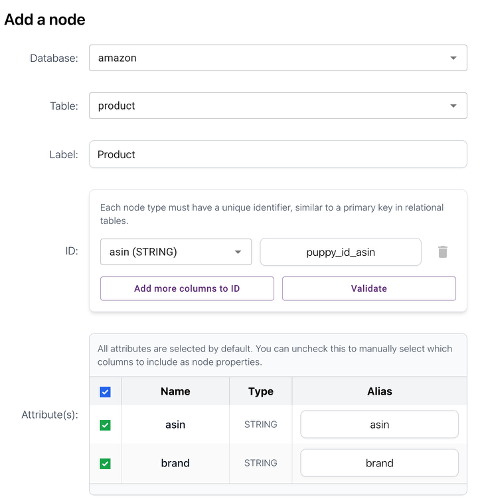
First we define Product nodes. For Product, select asin as the key, and add
these attributes: asin, brand.
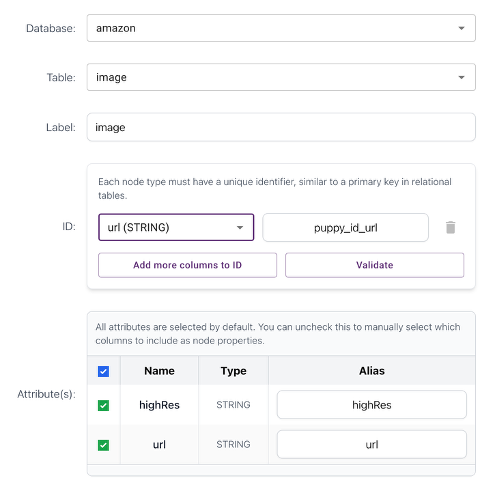
Then we define the Image nodes.
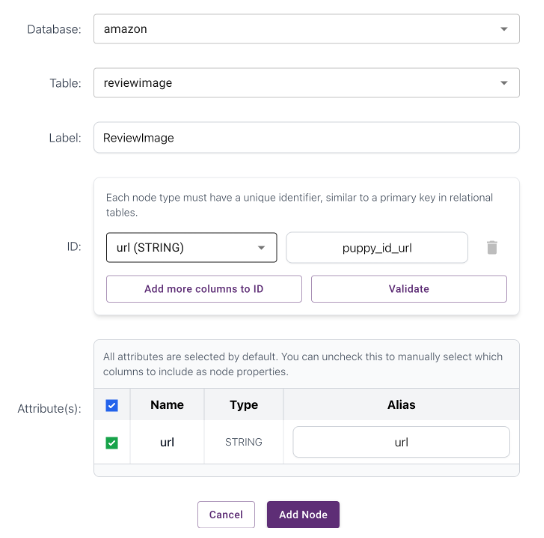
Then we define the ReviewImage nodes.
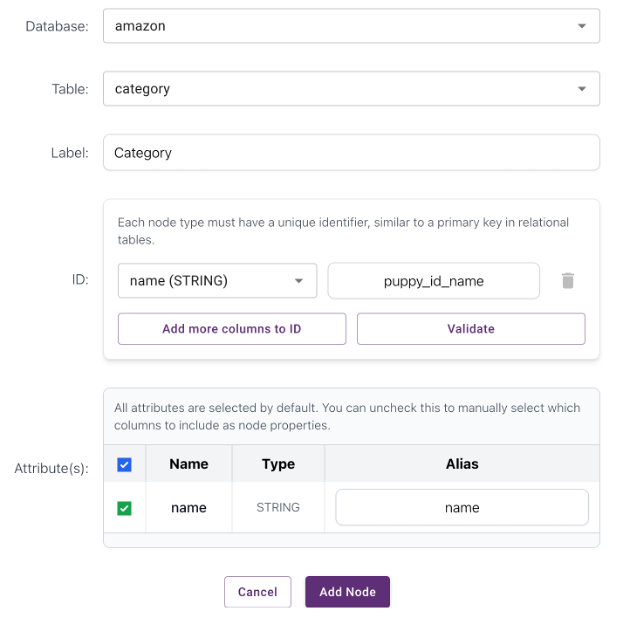
Then we define the Category nodes.
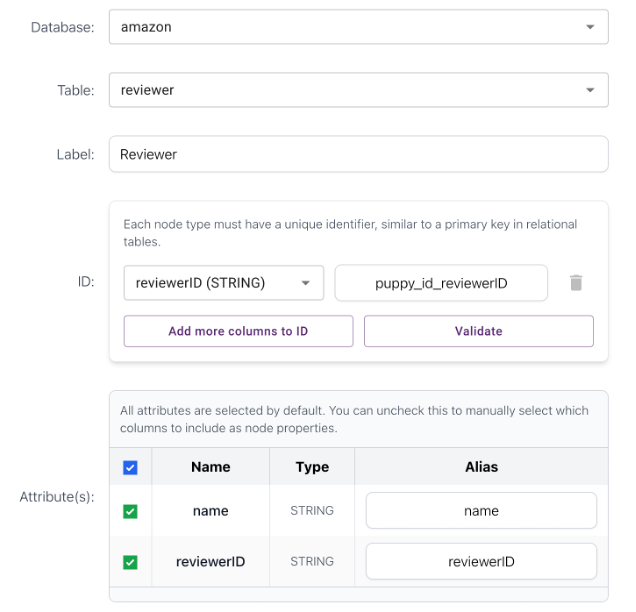
Then we define the Reviewer nodes.
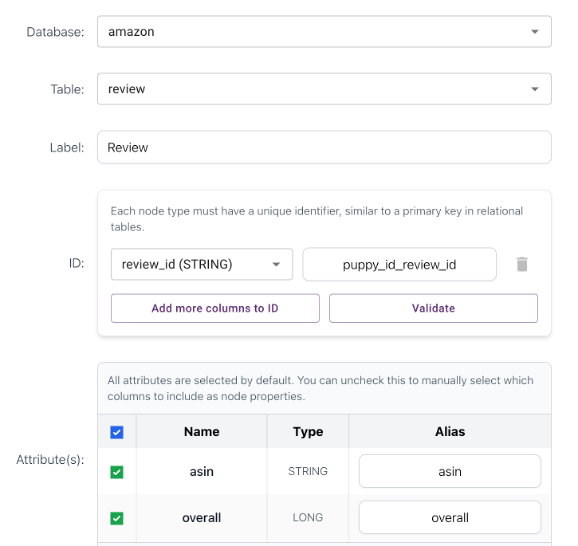
Then we define the Review nodes.
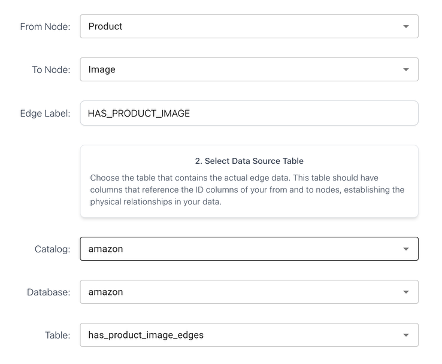
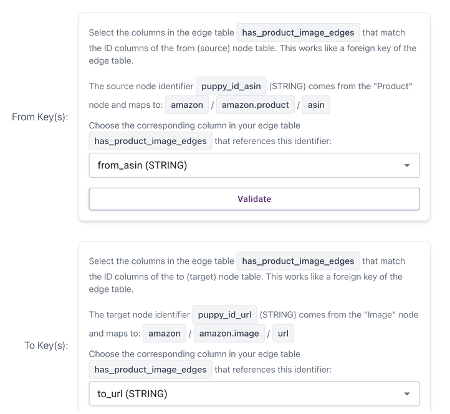
Define Edges
Then we define the HAS_PRODUCT_IMAGE edges from Product to
Image.
Then we define the HAS_REVIEW_IMAGE edges from Review to
ReviewImage.
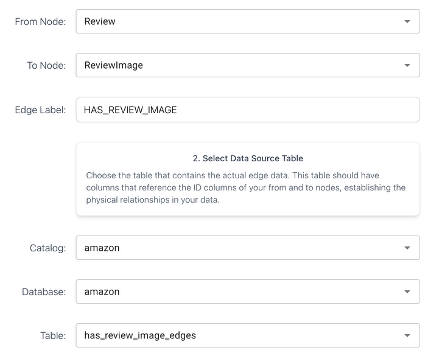
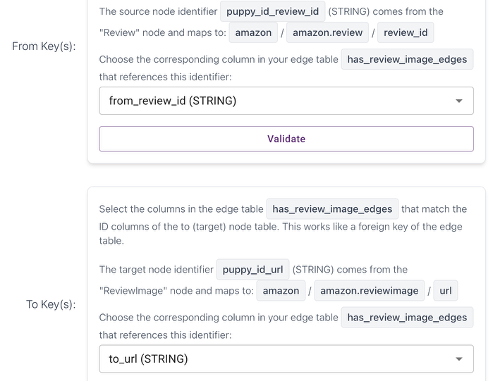
Then we define the ALSO_BUY edges from Product to
Product.
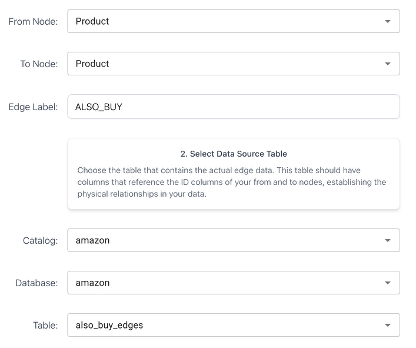
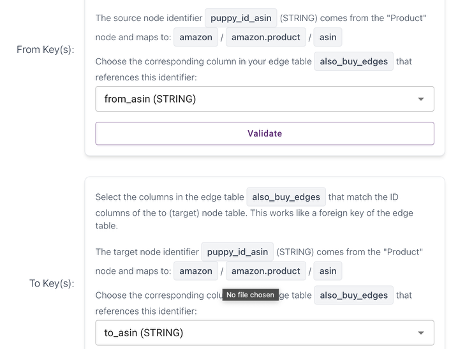
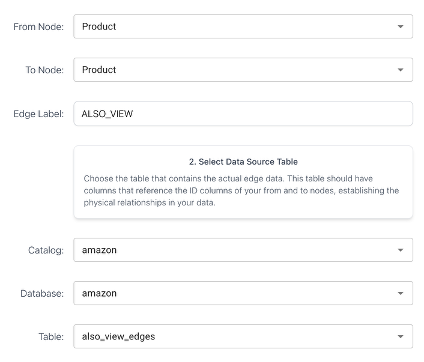
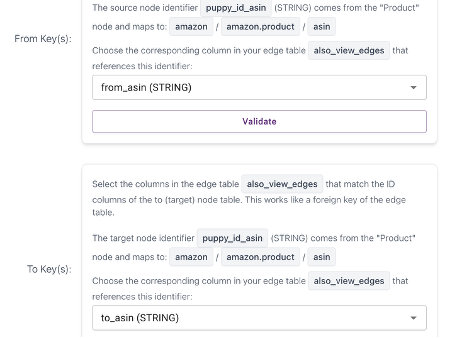
Then we define the ALSO_VIEW edges from Product to
Product.
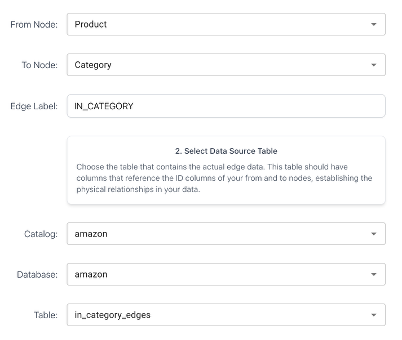
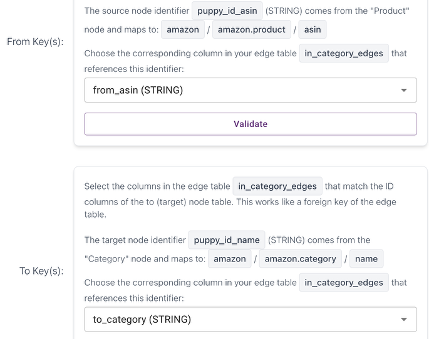
Then we define the IN_CATEGORY edges from Product to
Category.
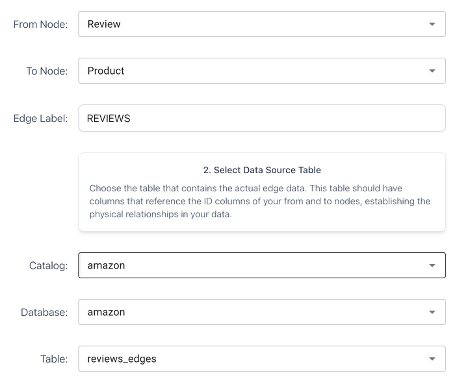
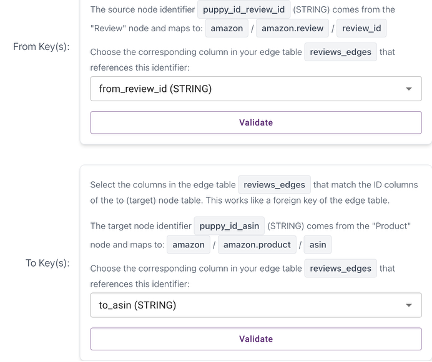
Then we define the REVIEWS edges from Review to
Product.
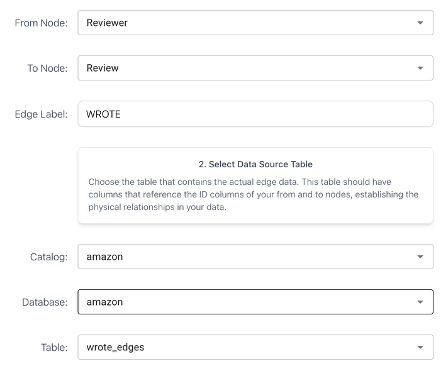
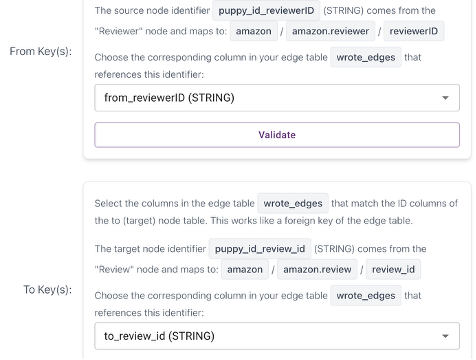
Then we define the WROTE edges from Reviewer to
Review.
Queries
Select a query below to view its logic and description.
Q1. Products with the Most Reviews
This query finds the 200 products with the highest number of reviews, marks them as seed products, and returns each product's identifier, display title, and review count.
MATCH (p:Product)<-[:REVIEWS]-(r:Review)
WITH p, count(r) AS ReviewCount
ORDER BY ReviewCount DESC
LIMIT 200
RETURN p.asin AS ASIN, coalesce(p.title, p.asin) AS Product, ReviewCount;
Equivalent query in GQL standard:
MATCH (p:Product)<-[:REVIEWS]-(r:Review)
WITH p, count(r) AS ReviewCount
ORDER BY ReviewCount DESC
LIMIT 200
SET p:SeedProduct
RETURN p.asin AS ASIN, coalesce(p.title, p.asin) AS Product, ReviewCount;
Q2. Highly Rated Products with Many Reviews
This query finds products with at least 50 reviews and an average rating of at least 4.0, returning the most-reviewed high-quality products first.
MATCH (p:Product)<-[:REVIEWS]-(r:Review)
WHERE r.overall IS NOT NULL
WITH p, avg(r.overall) AS AvgRating, count(r) AS ReviewCount
WHERE ReviewCount >= 50 AND AvgRating >= 4.0
RETURN p.asin AS ASIN,
    coalesce(p.title, p.asin) AS Product,
    round(AvgRating, 2) AS AvgRating,
    ReviewCount
ORDER BY ReviewCount DESC, AvgRating DESC
LIMIT 200;
Equivalent query in GQL standard:
MATCH (p:Product)<-[:REVIEWS]-(r:Review)
WHERE r.overall IS NOT NULL
WITH p, avg(r.overall) AS AvgRating, count(r) AS ReviewCount
WHERE ReviewCount >= 50 AND AvgRating >= 4.0
RETURN p.asin AS ASIN,
    coalesce(p.title, p.asin) AS Product,
    round(AvgRating, 2) AS AvgRating,
    ReviewCount
ORDER BY ReviewCount DESC, AvgRating DESC
LIMIT 200;
Q3. Most Active Reviewers
This query identifies the 200 reviewers who wrote the most reviews, marks them as top reviewers, and returns their IDs, names, and review counts.
MATCH (u:Reviewer)-[:WROTE]->(r:Review)
WITH u, count(r) AS ReviewCount
ORDER BY ReviewCount DESC
LIMIT 200
RETURN u.reviewerID AS ReviewerID,
    coalesce(u.name, u.reviewerID) AS ReviewerName,
    ReviewCount
ORDER BY ReviewCount DESC;
Equivalent query in GQL standard:
MATCH (u:Reviewer)-[:WROTE]->(r:Review)
WITH u, count(r) AS ReviewCount
ORDER BY ReviewCount DESC
LIMIT 200
SET u:TopReviewer
RETURN u.reviewerID AS ReviewerID,
    coalesce(u.name, u.reviewerID) AS ReviewerName,
    ReviewCount
ORDER BY ReviewCount DESC;
Q4. Reviewers Who Write the Longest Reviews
This query takes the top reviewers identified earlier and ranks them by the average length of their review text, returning reviewer identity, review count, and average review length.
MATCH (u:Reviewer)-[:WROTE]->(r:Review)
WHERE r.reviewText IS NOT NULL
WITH u,
    count(r) AS ReviewCount,
    avg(size(r.reviewText)) AS AvgReviewLength
ORDER BY ReviewCount DESC
LIMIT 200
RETURN u.reviewerID AS ReviewerID,
    coalesce(u.name, u.reviewerID) AS ReviewerName,
    ReviewCount,
    AvgReviewLength
ORDER BY AvgReviewLength DESC;
Equivalent query in GQL standard:
MATCH (u:TopReviewer)-[:WROTE]->(r:Review)
RETURN u.reviewerID AS ReviewerID,
    coalesce(u.name, u.reviewerID) AS ReviewerName,
    count(r) AS ReviewCount,
    avg(size(r.reviewText)) AS AvgReviewLength
ORDER BY AvgReviewLength DESC
LIMIT 200;
Q5. People Who Bought This Also Bought (Seed Expansion)
This query expands one hop from the seed products through ALSO_BUY edges, excludes
the seeds themselves, and ranks neighboring products by how many seed products link to them.
MATCH (p:Product)<-[:REVIEWS]-(r:Review)
WITH p, count(r) AS ReviewCount
ORDER BY ReviewCount DESC
LIMIT 200
WITH collect(p.asin) AS seedAsins
MATCH (seed:Product)-[:ALSO_BUY]->(other:Product)
WHERE seed.asin IN seedAsins AND NOT other.asin IN seedAsins
RETURN other.asin AS ASIN,
    coalesce(other.title, other.asin) AS CoBuyProduct,
    count(DISTINCT seed) AS LinkedSeeds
ORDER BY LinkedSeeds DESC
LIMIT 200;
Equivalent query in GQL standard:
MATCH (seed:SeedProduct)-[:ALSO_BUY]->(other:Product)
WHERE NOT other:SeedProduct
RETURN other.asin AS ASIN,
    coalesce(other.title, other.asin) AS CoBuyProduct,
    count(DISTINCT seed) AS LinkedSeeds
ORDER BY LinkedSeeds DESC
LIMIT 200;
Q6. Second-Hop Co-Buy Influence (Ripple Effect)
This query starts from the most-reviewed seed product, follows two ALSO_BUY hops,
and ranks second-hop products by how many first-hop neighbors connect back to them.
// Step 1: Pick the single most reviewed product
MATCH (seed:Product)<-[:REVIEWS]-(r:Review)
WITH seed, count(r) AS ReviewCount
ORDER BY ReviewCount DESC
LIMIT 1

// Step 2: First-hop co-buy neighbors
MATCH (seed)-[:ALSO_BUY]->(firstHop:Product)
WHERE firstHop <> seed

// Step 3: Second-hop neighbors (co-buys of firstHop)
MATCH (firstHop)-[:ALSO_BUY]->(secondHop:Product)
WHERE secondHop <> seed
RETURN secondHop.asin AS ASIN,
    coalesce(secondHop.title, secondHop.asin) AS SecondHopProduct,
    count(DISTINCT firstHop) AS SharedNeighbors
ORDER BY SharedNeighbors DESC
LIMIT 200;
Equivalent query in GQL standard:
MATCH (seed:SeedProduct)<-[:REVIEWS]-(review:Review)
WITH seed, count(review) AS ReviewCount
ORDER BY ReviewCount DESC
LIMIT 1
MATCH (seed)-[:ALSO_BUY]->(firstHop:Product)
WHERE NOT firstHop:SeedProduct
MATCH (firstHop)-[:ALSO_BUY]->(secondHop:Product)
WHERE secondHop <> seed
RETURN secondHop.asin AS ASIN,
    coalesce(secondHop.title, secondHop.asin) AS SecondHopProduct,
    count(DISTINCT firstHop) AS SharedNeighbors
ORDER BY SharedNeighbors DESC
LIMIT 200;
Q7. Most Popular Categories by Reviews
This query groups products by category and ranks categories by the total number of reviews attached to products in each category.
MATCH (c:Category)<-[:IN_CATEGORY]-(p:Product)<-[:REVIEWS]-(r:Review)
RETURN c.name AS Category,
    count(r) AS TotalReviews
ORDER BY TotalReviews DESC
LIMIT 200;
Equivalent query in GQL standard:
MATCH (c:Category)<-[:IN_CATEGORY]-(p:Product)<-[:REVIEWS]-(r:Review)
RETURN c.name AS Category,
    count(r) AS TotalReviews
ORDER BY TotalReviews DESC
LIMIT 200;
Q8. Top Brands by Average Rating
This query aggregates reviews across each product brand, keeps brands with at least 100 reviews, and ranks them by average rating.
MATCH (p:Product)<-[:REVIEWS]-(r:Review)
WHERE p.brand IS NOT NULL
WITH p.brand AS Brand, avg(r.overall) AS AvgRating, count(r) AS ReviewCount
WHERE ReviewCount >= 100
RETURN Brand,
    round(AvgRating, 2) AS AvgRating,
    ReviewCount
ORDER BY AvgRating DESC
LIMIT 200;
Equivalent query in GQL standard:
MATCH (p:Product)<-[:REVIEWS]-(r:Review)
WHERE p.brand IS NOT NULL
WITH p.brand AS Brand, avg(r.overall) AS AvgRating, count(r) AS ReviewCount
WHERE ReviewCount >= 100
RETURN Brand,
    round(AvgRating, 2) AS AvgRating,
    ReviewCount
ORDER BY AvgRating DESC
LIMIT 200;
Q9. Products with the Most Images
This query counts product image neighbors for each product and returns the products with the largest number of attached images.
MATCH (p:Product)-[:HAS_PRODUCT_IMAGE]->(i:Image)
WITH p.asin AS ASIN, coalesce(p.title, p.asin) AS Product, count(i) AS ImageCount
RETURN ASIN, Product, ImageCount
ORDER BY ImageCount DESC
LIMIT 200;
Equivalent query in GQL standard:
MATCH (p:Product)-[:HAS_PRODUCT_IMAGE]->(i:Image)
WITH p.asin AS ASIN, coalesce(p.title, p.asin) AS Product, count(i) AS ImageCount
RETURN ASIN, Product, ImageCount
ORDER BY ImageCount DESC
LIMIT 200;
Q10. Images reused by multiple products (Image-Centric View)
This query switches to an image-centric view and ranks images by the number of distinct products that reuse the same image URL.
MATCH (p:Product)-[:HAS_IMAGE]->(i:Image)
RETURN i.url AS ImageURL,
    count(DISTINCT p) AS ProductCount
ORDER BY ProductCount DESC
LIMIT 200;
Equivalent query in GQL standard:
MATCH (p:Product)-[:HAS_IMAGE]->(i:Image)
RETURN i.url AS ImageURL,
    count(DISTINCT p) AS ProductCount
ORDER BY ProductCount DESC
LIMIT 200;
Q11. Are Reviews with More Images More Helpful?
This query finds highly helpful reviews, counts any images attached to each review, and returns reviewer, rating, helpful-vote, and image-count fields for comparison.
MATCH (r:Review)
WHERE r.vote IS NOT NULL
OPTIONAL MATCH (r)-[:HAS_IMAGE]->(ri:ReviewImage)
WITH r.reviewerID AS ReviewerID,
    coalesce(r.reviewerID, "Unknown") AS ReviewerName,
    r.overall AS Rating,
    r.vote AS HelpfulVotes,
    count(ri) AS ImageCount
RETURN ReviewerID, ReviewerName, Rating, HelpfulVotes, ImageCount
ORDER BY HelpfulVotes DESC
LIMIT 200;
Equivalent query in GQL standard:
MATCH (r:Review)
WHERE r.vote IS NOT NULL
OPTIONAL MATCH (r)-[:HAS_IMAGE]->(ri:ReviewImage)
WITH r.reviewerID AS ReviewerID,
    coalesce(r.reviewerID, "Unknown") AS ReviewerName,
    r.overall AS Rating,
    r.vote AS HelpfulVotes,
    count(ri) AS ImageCount
RETURN ReviewerID, ReviewerName, Rating, HelpfulVotes, ImageCount
ORDER BY HelpfulVotes DESC
LIMIT 200;