Schema Diagram and Graph Statistics
Since GraphFrames has no support for printing a graph schema, we reuse the one output from Neo4j.
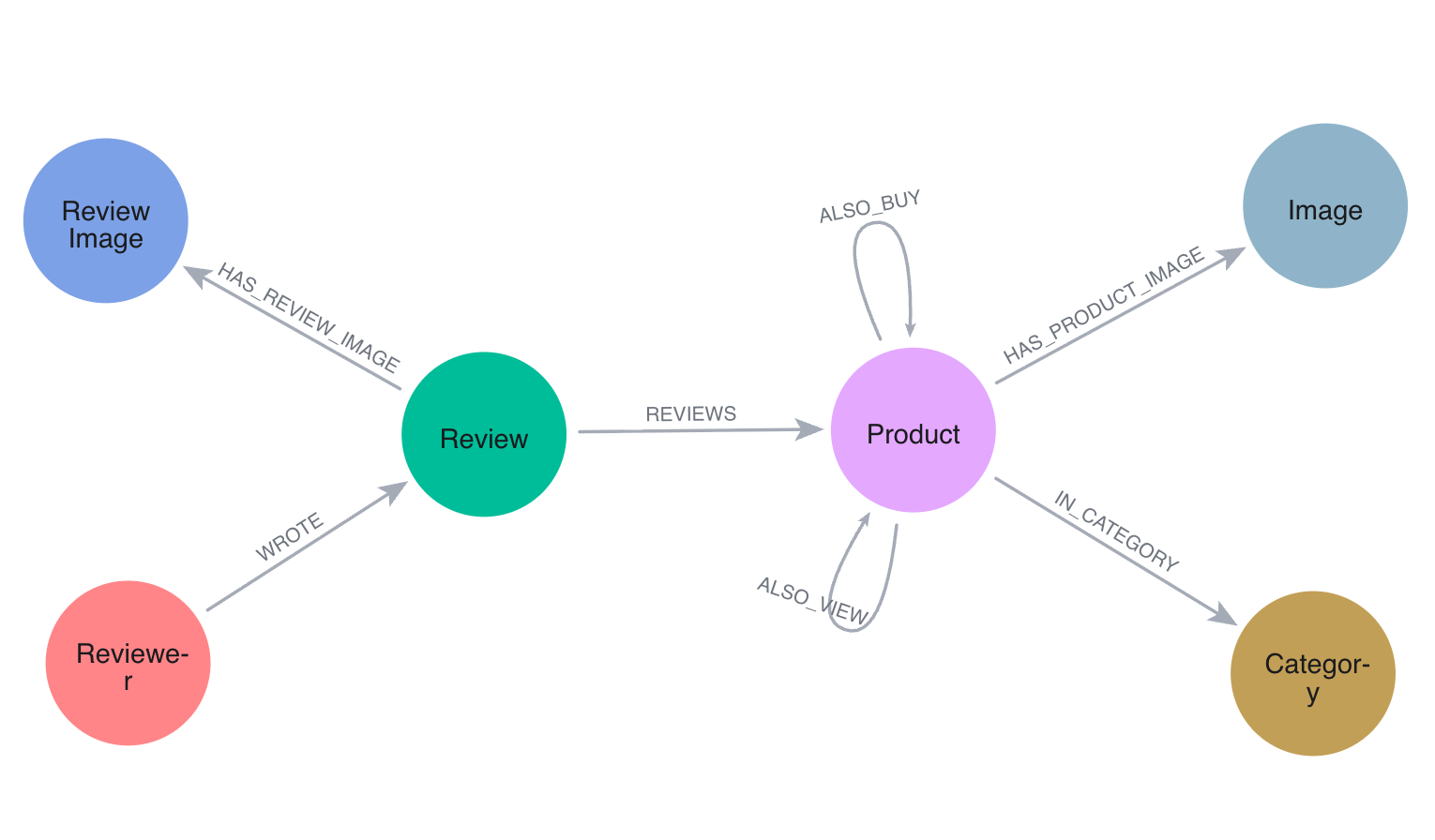
Node Statistics
| Node Label | Count |
|---|---|
| Product | 23,643,222 |
| Category | 2,487,388 |
| Review | 230,139,802 |
| Image | 17,081,240 |
| ReviewImage | 6,538,802 |
| Reviewer | 43,249,276 |
Edge Statistics
| Relationship | Count |
|---|---|
| (:Review)-[:REVIEWS]->(:Product) | 230,139,802 |
| (:Product)-[:HAS_PRODUCT_IMAGE]->(:Image) | 22,531,444 |
| (:Product)-[:ALSO_BUY]->(:Product) | 97,123,542 |
| (:Reviewer)-[:WROTE]->(:Review) | 230,139,802 |
| (:Review)-[:HAS_REVIEW_IMAGE]->(:ReviewImage) | 6,840,462 |
| (:Product)-[:IN_CATEGORY]->(:Category) | 62,832,310 |
| (:Product)-[:ALSO_VIEW]->(:Product) | 92,658,319 |
Every vertex and edge count matches the Neo4j load exactly. One category name differs: Neo4j holds a
Category whose name is the empty string, which here, as in the TigerGraph
load, is named <null>.
Data Loading
Overview
Data import is handled in three parts. First we read the input files into DataFrames. Then we define
nodes and edges, applying the same MERGE semantics as the Neo4j loader: every node and
edge is deduplicated on its key, and a Product that is only referenced by an edge or a
review exists with null attributes. Finally, we save every node and edge type as a Delta table in the
Hive metastore (database amazon, shared with PuppyGraph) and create the graph from
those tables.
The input is the same set of tab-separated files the TigerGraph load reads: eleven files per Amazon
category folder (product.tsv, review.tsv, also_buy.tsv, ...),
each with a header row and no quoting, with tab, newline, carriage return, backslash and other control
characters inside a field written as escape sequences. Every node id is prefixed with its type
(product:B00006RVQO) so that ids are unique across the graph, and the Neo4j key property
(asin, name, url, reviewerID) is kept as its own
column.
DataFrames
We defined a few helper functions to read the files, decode the escape sequences, turn empty numeric fields into nulls, and keep one row per key.
TSV_ROOT = Path('/datasets/prop_datasets/amazon/tg_tsv2')
CATEGORIES = sorted(p.name for p in TSV_ROOT.iterdir() if p.is_dir())

def read_tsv(name, columns):
    # One file per category folder, header row, tab-separated, no quoting.
    paths = [(TSV_ROOT / c / f'{name}.tsv').as_uri() for c in CATEGORIES]
    schema = StructType([StructField(c, StringType()) for c in columns])
    df = (spark.read.format('csv').schema(schema)
          .option('sep', '\t').option('header', 'true')
          .option('quote', '').option('escape', '\u0000')
          .option('ignoreLeadingWhiteSpace', 'false').option('ignoreTrailingWhiteSpace', 'false')
          .option('mode', 'FAILFAST')
          .load(paths))
    # Spark reads an unquoted empty field as null; the files hold no nulls, so restore "".
    return df.select(*[F.coalesce(F.col(c), F.lit('')).alias(c) for c in columns])

# Decode the \\ \t \n \r \xNN escapes back to the raw characters Neo4j holds.
_CTRL = [i for i in list(range(0x20)) + [0x7F] if i not in (0x09, 0x0A, 0x0D)]

def _decode_segment(s):
    for escape, char in (('\\t', '\t'), ('\\n', '\n'), ('\\r', '\r')):
        s = F.replace(s, F.lit(escape), F.lit(char))
    for i in _CTRL:
        s = F.replace(s, F.lit('\\x%02x' % i), F.lit(chr(i)))
    return s

def decoded(column):
    c = F.col(column)
    full = F.array_join(F.transform(F.split(c, r'\\\\'), _decode_segment), '\\')
    return F.when(c.contains('\\'), full).otherwise(c).alias(column)

def decode_columns(df, columns):
    return df.select(*[decoded(c) if c in columns else F.col(c) for c in df.columns])

def empty_to_null(column, spark_type):
    # "" in a numeric/datetime column is Cypher's null (toFloat/toInteger failed).
    c = F.col(column)
    return F.when(c == '', F.lit(None)).otherwise(c).cast(spark_type).alias(column)

def vid(family, column):
    return F.concat(F.lit(f'{family}:'), F.col(column))

def greatest_per_key(df, key, value_columns):
    # MERGE + SET keeps one row per key; the greatest row wins, deterministically.
    return (df.groupBy(key)
            .agg(F.max(F.struct(*value_columns)).alias('_v'))
            .select(key, *[F.col(f'_v.{c}').alias(c) for c in value_columns]))
Define Nodes
First we define the Review node. review_id is a key added for the
TigerGraph load (Neo4j's Review nodes have none); it is unique per review row.
review_raw = read_tsv('review', ['review_id', 'reviewerID', 'asin', 'unixReviewTime',
                                 'reviewDatetime', 'summary', 'reviewText', 'verified',
                                 'vote', 'overall'])
review_raw = decode_columns(review_raw, ['review_id', 'reviewerID', 'asin', 'summary', 'reviewText'])
review_vertices_df = review_raw.select(
    vid('review', 'review_id').alias('id'), F.lit('review').alias('type'),
    'review_id', 'reviewerID', 'asin',
    empty_to_null('unixReviewTime', 'bigint'),
    F.to_timestamp(F.when(F.col('reviewDatetime') == '', None)
                   .otherwise(F.col('reviewDatetime')), 'yyyy-MM-dd HH:mm:ss').alias('reviewDatetime'),
    'summary', 'reviewText',
    F.when(F.col('verified') == 'true', True)
     .when(F.col('verified') == 'false', False).alias('verified'),
    empty_to_null('vote', 'int'),
    empty_to_null('overall', 'int'))
review_vertices_df.printSchema(); review_vertices_df.show(3, truncate=80)
Then we define the Reviewer node.
reviewer_raw = decode_columns(read_tsv('reviewer', ['reviewerID', 'name']), ['reviewerID', 'name'])
reviewer_vertices_df = greatest_per_key(reviewer_raw, 'reviewerID', ['name']).select(
    vid('reviewer', 'reviewerID').alias('id'), F.lit('reviewer').alias('type'),
    'reviewerID', 'name')
reviewer_vertices_df.printSchema(); reviewer_vertices_df.show(3, truncate=80)
Then we define the ReviewImage node.
reviewimage_raw = decode_columns(read_tsv('review_image', ['url']), ['url'])
reviewimage_vertices_df = reviewimage_raw.distinct().select(
    vid('reviewimage', 'url').alias('id'), F.lit('reviewimage').alias('type'), 'url')
reviewimage_vertices_df.printSchema(); reviewimage_vertices_df.show(3, truncate=80)
Then we define the Category node.
category_raw = decode_columns(read_tsv('category', ['name']), ['name'])
category_vertices_df = category_raw.distinct().select(
    vid('category', 'name').alias('id'), F.lit('category').alias('type'), 'name')
category_vertices_df.printSchema(); category_vertices_df.show(3, truncate=80)
Then we define the Image node.
image_raw = decode_columns(read_tsv('image', ['url', 'highRes']), ['url', 'highRes'])
image_vertices_df = greatest_per_key(image_raw, 'url', ['highRes']).select(
    vid('image', 'url').alias('id'), F.lit('image').alias('type'), 'url', 'highRes')
image_vertices_df.printSchema(); image_vertices_df.show(3, truncate=80)
Then we define the Product node, from the product metadata plus every ASIN referenced by
a co-buy, co-view or review.
text = ['asin', 'title', 'brand', 'description']
product_raw = decode_columns(read_tsv('product', text + ['price_min', 'price_max']), text)
product_meta = greatest_per_key(
    product_raw.select(*text, empty_to_null('price_min', 'double'),
                       empty_to_null('price_max', 'double')),
    'asin', ['title', 'brand', 'description', 'price_min', 'price_max'])

# Products that only exist because an ALSO_BUY / ALSO_VIEW edge or a review points at
# them: Neo4j's MERGE (p:Product {asin}) creates them with no other property.
referenced = (
    decode_columns(read_tsv('also_buy', ['asin', 'related_asin']), ['related_asin'])
        .select(F.col('related_asin').alias('asin'))
    .unionByName(decode_columns(read_tsv('also_view', ['asin', 'view_asin']), ['view_asin'])
        .select(F.col('view_asin').alias('asin')))
    .unionByName(review_vertices_df.select('asin'))
    .distinct())
product_vertices_df = (referenced.join(product_meta, 'asin', 'full_outer')
    .select(vid('product', 'asin').alias('id'), F.lit('product').alias('type'),
            'asin', 'title', 'brand', 'description', 'price_min', 'price_max'))
product_vertices_df.printSchema(); product_vertices_df.show(3, truncate=80)
Define Edges
Next step is to define edges. First we define the REVIEWS and WROTE edges,
which come from columns of the review rows.
reviews_edges_df = review_vertices_df.select(
    F.col('id').alias('src'), vid('product', 'asin').alias('dst'), F.lit('reviews').alias('etype'))
reviews_edges_df.printSchema(); reviews_edges_df.show(3, truncate=80)
wrote_edges_df = review_vertices_df.select(
    vid('reviewer', 'reviewerID').alias('src'), F.col('id').alias('dst'), F.lit('wrote').alias('etype'))
wrote_edges_df.printSchema(); wrote_edges_df.show(3, truncate=80)
Then we define the HAS_REVIEW_IMAGE edge.
has_review_image_raw = decode_columns(read_tsv('review_has_image', ['review_id', 'url']),
                                      ['review_id', 'url'])
has_review_image_edges_df = has_review_image_raw.distinct().select(
    vid('review', 'review_id').alias('src'), vid('reviewimage', 'url').alias('dst'),
    F.lit('has_review_image').alias('etype'))
has_review_image_edges_df.printSchema(); has_review_image_edges_df.show(3, truncate=80)
Then we define the ALSO_BUY edge.
also_buy_raw = decode_columns(read_tsv('also_buy', ['asin', 'related_asin']), ['asin', 'related_asin'])
also_buy_edges_df = also_buy_raw.distinct().select(
    vid('product', 'asin').alias('src'), vid('product', 'related_asin').alias('dst'),
    F.lit('also_buy').alias('etype'))
also_buy_edges_df.printSchema(); also_buy_edges_df.show(3, truncate=80)
Then we define the ALSO_VIEW edge.
also_view_raw = decode_columns(read_tsv('also_view', ['asin', 'view_asin']), ['asin', 'view_asin'])
also_view_edges_df = also_view_raw.distinct().select(
    vid('product', 'asin').alias('src'), vid('product', 'view_asin').alias('dst'),
    F.lit('also_view').alias('etype'))
also_view_edges_df.printSchema(); also_view_edges_df.show(3, truncate=80)
Then we define the IN_CATEGORY edge.
in_category_raw = decode_columns(read_tsv('product_category', ['asin', 'name']), ['asin', 'name'])
in_category_edges_df = in_category_raw.distinct().select(
    vid('product', 'asin').alias('src'), vid('category', 'name').alias('dst'),
    F.lit('in_category').alias('etype'))
in_category_edges_df.printSchema(); in_category_edges_df.show(3, truncate=80)
Then we define the HAS_PRODUCT_IMAGE edge.
has_product_image_raw = decode_columns(read_tsv('product_image', ['asin', 'url']), ['asin', 'url'])
has_product_image_edges_df = has_product_image_raw.distinct().select(
    vid('product', 'asin').alias('src'), vid('image', 'url').alias('dst'),
    F.lit('has_product_image').alias('etype'))
has_product_image_edges_df.printSchema(); has_product_image_edges_df.show(3, truncate=80)
Define Graph
Now that we have defined our vertices and edges, we save each type as a Delta table and register it in the Hive metastore.
vertex_source_dfs = {
    'product': product_vertices_df, 'category': category_vertices_df, 'image': image_vertices_df,
    'reviewimage': reviewimage_vertices_df, 'reviewer': reviewer_vertices_df,
    'review': review_vertices_df}
edge_source_dfs = {
    'product_alsobuy_product': also_buy_edges_df, 'product_alsoview_product': also_view_edges_df,
    'product_incategory_category': in_category_edges_df,
    'product_hasproductimage_image': has_product_image_edges_df,
    'review_reviews_product': reviews_edges_df, 'reviewer_wrote_review': wrote_edges_df,
    'review_hasreviewimage_reviewimage': has_review_image_edges_df}

OUTPUT_ROOT = 'hdfs://master:9000/user/hive/warehouse/amazon'
spark.sql('CREATE DATABASE IF NOT EXISTS amazon')
for name, df in {**vertex_source_dfs, **edge_source_dfs}.items():
    path = f'{OUTPUT_ROOT}/{name}'
    df.write.format('delta').mode('overwrite').option('overwriteSchema', 'true').save(path)
    spark.sql(f'DROP TABLE IF EXISTS amazon.amazon_{name}')
    spark.sql(f"CREATE TABLE amazon.amazon_{name} USING DELTA LOCATION '{path}'")
Finally, we can create the whole graph. All vertex tables are unioned into a single vertex DataFrame and all edge tables into a single edge DataFrame.
def load_table(name, column):
    # `type` / `etype` are constant per table; as a literal, a filter on them
    # prunes the other tables from the plan.
    frame = spark.table(f'amazon.amazon_{name}')
    kind = frame.select(column).first()[column]
    return frame.drop(column).withColumn(column, F.lit(kind))

def union_all(frames):
    return reduce(lambda left, right: left.unionByName(right, allowMissingColumns=True), frames)

vertices = union_all([load_table(name, 'type') for name in vertex_source_dfs])
edges = union_all([load_table(name, 'etype') for name in edge_source_dfs])
g = GraphFrame(vertices, edges)
Queries
Select a query below to view its logic and description. Every query runs on the graph
g built above; the definitions below are shared by several queries.
from graphframes import GraphFrame
from pyspark.sql import functions as F

SEED_ASIN = "0000031895"
TARGET_ASIN = "B00JM8YXXG"

products = g.vertices.filter(F.col("type") == "product")
reviews = g.vertices.filter(F.col("type") == "review")
reviewers = g.vertices.filter(F.col("type") == "reviewer")


def edges_of(etype):
    return g.edges.filter(F.col("etype") == etype).select("src", "dst", "etype")


# Co-buy graph: Product -[ALSO_BUY]-> Product, plus an undirected copy.
cobuy_vertices = products.select("id", "type", "asin", "title", "price_min")
cobuy_edges = edges_of("also_buy")
cobuy = GraphFrame(cobuy_vertices, cobuy_edges)
cobuy_edges_undirected = cobuy_edges.unionByName(
    cobuy_edges.selectExpr("dst AS src", "src AS dst", "etype")
)
cobuy_undirected = GraphFrame(cobuy_vertices, cobuy_edges_undirected)


def display_title(vertex):
    """coalesce(v.title, v.asin) for a motif vertex column."""
    return F.coalesce(F.col(f"{vertex}.title"), F.col(f"{vertex}.asin"))


# Q16's ranking, used by Q1, Q16 and Q30: products by incoming REVIEWS.
product_review_counts = (
    g.find("(r)-[e]->(p)")
    .filter(
        (F.col("e.etype") == "reviews")
        & (F.col("r.type") == "review")
        & (F.col("p.type") == "product")
    )
    .groupBy(F.col("p.id").alias("id"))
    .agg(F.count("*").alias("ReviewCount"))
)
seed_products = (
    product_review_counts
    .join(products.select("id", "asin", "title"), "id")
    .orderBy(F.col("ReviewCount").desc(), F.col("asin").asc())
    .limit(200)
)

# Q18's ranking, used by Q15 and Q18: reviewers by outgoing WROTE.
top_reviewers = (
    g.find("(u)-[w]->(r)")
    .filter(
        (F.col("w.etype") == "wrote")
        & (F.col("u.type") == "reviewer")
        & (F.col("r.type") == "review")
    )
    .groupBy(
        F.col("u.id").alias("id"),
        F.col("u.reviewerID").alias("reviewerID"),
        F.col("u.name").alias("name"),
    )
    .agg(F.count("*").alias("ReviewCount"))
    .orderBy(F.col("ReviewCount").desc(), F.col("reviewerID").asc())
    .limit(200)
)


# Used by Q27-Q29.
CHECKPOINT_DIR = 'hdfs://master:9000/tmp/spark-checkpoints'

def component_sizes(frame, column, id_name, size_name):
    return (
        frame.groupBy(column)
        .agg(F.count('*').alias(size_name))
        .select(F.col(column).alias(id_name), size_name)
        .orderBy(F.col(size_name).desc(), F.col(id_name).asc())
        .limit(100)
    )
- Every Product property Neo4j would hold is a column; Products that exist only because an edge points at them have null attributes, so coalesce(p.title, p.asin) behaves as in Cypher (a metadata product with an empty title keeps "").
- Cypher patterns written -[:ALSO_BUY]- are undirected. GraphFrames walks src -> dst, so
cobuy_undirectedadds a reversed copy of every edge and does NOT deduplicate: Neo4j treats each stored relationship as its own match in an undirected pattern. - Cypher MATCH requires the relationships of one pattern to be distinct but lets nodes repeat. Where that matters (variable-length paths Q9/Q22/Q23, the 4-cycle Q11) it is spelled out at the query.
- Where Cypher's ORDER BY leaves ties, a secondary key on the returned identifiers is added so the 200/100 rows are reproducible. It never changes which rows a tie-free ordering would return.
- Q16/Q18 attach :SeedProduct / :TopReviewer labels in Neo4j. DataFrames are immutable, so Q16/Q18 return their ranking only (the SET is dropped), and Q1/Q15/Q30 recompute that ranking inline -- as the TigerGraph translation does, with the same tie-break (count DESC, key ASC).
- Q6/Q7 (BFS) and Q26-Q29 (graph algorithms) run eagerly, so they are built inside the runner's measured job group, not here; their sections below document the translation and are replaced at load time.
Q1. People Who Bought This Also Bought (Seed Expansion)
This query expands one hop from the seed products through ALSO_BUY edges, excludes
the seeds themselves, and ranks neighboring products by how many seed products link to them.
seed_ids = seed_products.select(F.col("id").alias("seed_id"))
q1 = (
    cobuy.find("(seed)-[e]->(other)")
    .join(seed_ids, F.col("seed.id") == F.col("seed_id"), "left_semi")
    .join(seed_ids, F.col("other.id") == F.col("seed_id"), "left_anti")
    .groupBy(F.col("other.asin").alias("ASIN"),
             display_title("other").alias("CoBuyProduct"))
    .agg(F.countDistinct("seed.id").alias("LinkedSeeds"))
    .orderBy(F.col("LinkedSeeds").desc(), F.col("ASIN").asc())
    .limit(200)
)
GraphFrames notes
(seed:SeedProduct)-[:ALSO_BUY]->(other) WHERE NOT other:SeedProduct
Equivalent query in GQL standard:
MATCH (seed:SeedProduct)-[:ALSO_BUY]->(other:Product)
WHERE NOT other:SeedProduct
RETURN other.asin AS ASIN,
    coalesce(other.title, other.asin) AS CoBuyProduct,
    count(DISTINCT seed) AS LinkedSeeds
ORDER BY LinkedSeeds DESC
LIMIT 200;
Q2. Two-Hop Co-Buy Recommendations
This query expands from a selected product through two outgoing ALSO_BUY hops and
returns distinct second-hop products.
q2 = (
    cobuy.find("(s)-[e1]->(m); (m)-[e2]->(rec)")
    .filter((F.col("s.asin") == SEED_ASIN) & (F.col("rec.asin") != SEED_ASIN))
    .select(F.col("rec.asin").alias("ASIN"), display_title("rec").alias("Product"))
    .distinct()
    .orderBy("Product", "ASIN")
    .limit(200)
)
Equivalent query in GQL standard:
MATCH (:Product {asin: $asin})-[:ALSO_BUY]->(:Product)-[:ALSO_BUY]->(rec:Product)
WHERE rec.asin <> $asin
RETURN DISTINCT rec.asin AS ASIN, coalesce(rec.title, rec.asin) AS Product
ORDER BY Product
LIMIT $limit;
Q3. Products Exactly Two Co-Buy Hops Away
This query returns products exactly two ALSO_BUY hops from a selected product,
excluding direct one-hop recommendations.
q3 = (
    cobuy.find("(s)-[e1]->(m); (m)-[e2]->(second); !(s)-[]->(second)")
    .filter((F.col("s.asin") == SEED_ASIN) & (F.col("second.id") != F.col("s.id")))
    .select(F.col("second.asin").alias("ASIN"), display_title("second").alias("Product"))
    .distinct()
    .orderBy("Product", "ASIN")
    .limit(200)
)
GraphFrames notes
NOT (seed)-[:ALSO_BUY]->(second) is a GraphFrames negated edge.
Equivalent query in GQL standard:
MATCH (seed:Product {asin: $asin})-[:ALSO_BUY]->(:Product)-[:ALSO_BUY]->(second:Product)
WHERE second <> seed
  AND NOT (seed)-[:ALSO_BUY]->(second)
RETURN DISTINCT second.asin AS ASIN, coalesce(second.title, second.asin) AS Product
ORDER BY Product
LIMIT $limit;
Q4. Highly Rated Co-Buy Neighbors
This query filters one-hop co-buy neighbors to products whose review average meets a minimum rating threshold.
q4 = (
    g.find("(s)-[e1]->(p); (r)-[e2]->(p)")
    .filter(
        (F.col("e1.etype") == "also_buy") & (F.col("e2.etype") == "reviews")
        & (F.col("s.type") == "product") & (F.col("p.type") == "product")
        & (F.col("r.type") == "review")
        & (F.col("s.asin") == SEED_ASIN)
        & F.col("r.overall").isNotNull()
    )
    .groupBy(F.col("p.asin").alias("ASIN"), display_title("p").alias("Product"))
    .agg(F.avg("r.overall").alias("_avg"), F.count("r.id").alias("ReviewCount"))
    .filter(F.col("_avg") >= 4.0)
    .select("ASIN", "Product", F.round("_avg", 2).alias("AvgRating"), "ReviewCount")
    .orderBy(F.col("AvgRating").desc(), F.col("ReviewCount").desc(), F.col("ASIN").asc())
    .limit(100)
)
GraphFrames notes
ORDER BY AvgRating refers to the returned, rounded AvgRating.
Equivalent query in GQL standard:
MATCH (:Product {asin: $asin})-[:ALSO_BUY]->(p:Product)<-[:REVIEWS]-(r:Review)
WHERE r.overall IS NOT NULL
WITH p, avg(r.overall) AS AvgRating, count(r) AS ReviewCount
WHERE AvgRating >= $minRating
RETURN p.asin AS ASIN, coalesce(p.title, p.asin) AS Product, round(AvgRating, 2) AS AvgRating, ReviewCount
ORDER BY AvgRating DESC, ReviewCount DESC
LIMIT $limit;
Q5. High-Rating Helpful Review Records
Reviews are modeled as nodes between reviewers and products, so this query filters review-edge records by rating and helpful-vote properties.
q5 = (
    g.find("(u)-[w]->(r); (r)-[rv]->(p)")
    .filter(
        (F.col("w.etype") == "wrote") & (F.col("rv.etype") == "reviews")
        & (F.col("u.type") == "reviewer") & (F.col("r.type") == "review")
        & (F.col("p.type") == "product")
        & (F.col("r.overall") >= 4.0)
        & (F.coalesce(F.col("r.vote"), F.lit(0)) >= 10)
    )
    .select(
        F.col("u.reviewerID").alias("ReviewerID"),
        F.col("p.asin").alias("ASIN"),
        F.col("r.overall").alias("Rating"),
        F.col("r.vote").alias("HelpfulVotes"),
    )
    .orderBy(F.col("HelpfulVotes").desc(), F.col("Rating").desc(),
             F.col("ReviewerID").asc(), F.col("ASIN").asc())
    .limit(100)
)
Equivalent query in GQL standard:
MATCH (u:Reviewer)-[:WROTE]->(r:Review)-[:REVIEWS]->(p:Product)
WHERE r.overall >= $minRating
  AND coalesce(r.vote, 0) >= $minHelpfulVotes
RETURN u.reviewerID AS ReviewerID, p.asin AS ASIN, r.overall AS Rating, r.vote AS HelpfulVotes
ORDER BY HelpfulVotes DESC, Rating DESC
LIMIT $limit;
Q6. Reachability Between Products in the Co-Buy Graph
This query tests whether one product can reach another product through up to four
ALSO_BUY hops.
def build_q6():
    path = cobuy.bfs(
        fromExpr=f"asin = '{SEED_ASIN}'",
        toExpr=f"asin = '{TARGET_ASIN}'",
        maxPathLength=4,
    ).limit(1)
    return path.agg((F.count("*") > 0).alias("reachable"))
GraphFrames notes
cobuy.bfs(asin = SEED -> asin = TARGET, maxPathLength=4).limit(1), then count(*) > 0 AS reachable. A path of length 1..4 exists iff the shortest one is at most 4 hops, so BFS decides it.
This one runs eagerly (a BFS / graph algorithm), so it is written as a function that the benchmark runner calls inside the measured Spark job group.
Equivalent query in GQL standard:
MATCH p = ANY (:Product {asin: $sourceAsin})-[:ALSO_BUY]->{1,4}(:Product {asin: $targetAsin})
RETURN true AS reachable;
Q7. Shortest Co-Buy Path Between Products
This query finds the shortest directed co-buy path between two products within a bounded depth.
def build_q7():
    bfs = cobuy.bfs(
        fromExpr=f"asin = '{SEED_ASIN}'",
        toExpr=f"asin = '{TARGET_ASIN}'",
        maxPathLength=6,
    )
    intermediate = sorted(
        [column for column in bfs.columns if re.fullmatch(r"v\d+", column)],
        key=lambda column: int(column[1:]),
    )
    vertex_columns = ["from"] + intermediate + ["to"]
    hop_count = len([column for column in bfs.columns if re.fullmatch(r"e\d+", column)])
    return (
        bfs.select(
            F.array(*[F.col(f"{column}.asin") for column in vertex_columns]).alias("ProductPath"),
            F.lit(hop_count).alias("HopCount"),
        )
        .orderBy("ProductPath")
        .limit(1)
    )
GraphFrames notes
cobuy.bfs(..., maxPathLength=6), path rendered as the array of asins, one path kept (Neo4j's shortestPath also returns one).
This one runs eagerly (a BFS / graph algorithm), so it is written as a function that the benchmark runner calls inside the measured Spark job group.
Equivalent query in GQL standard:
MATCH p = SHORTEST (:Product {asin: $sourceAsin})-[:ALSO_BUY]->{1,6}(:Product {asin: $targetAsin})
RETURN p;
Q8. Simple Co-Buy Paths up to Three Hops
This query enumerates acyclic co-buy paths between two products up to three hops.
def seed_to_target_paths(hops, all_nodes_distinct):
    names = ["a", "b", "c", "d"][: hops + 1]
    pattern = "; ".join(f"({names[i]})-[e{i + 1}]->({names[i + 1]})" for i in range(hops))
    cond = (F.col("a.asin") == SEED_ASIN) & (F.col(f"{names[-1]}.asin") == TARGET_ASIN)
    if all_nodes_distinct:
        for i in range(len(names)):
            for j in range(i + 1, len(names)):
                cond = cond & (F.col(f"{names[i]}.id") != F.col(f"{names[j]}.id"))
    elif hops == 3:
        # Relationship isomorphism: e1 = (a,b) and e3 = (c,d) are the same
        # edge iff a = c and b = d. Adjacent edges could only coincide on a
        # self-loop, and ALSO_BUY has none.
        cond = cond & ~((F.col("a.id") == F.col("c.id")) & (F.col("b.id") == F.col("d.id")))
    return (
        cobuy.find(pattern)
        .filter(cond)
        .select(
            F.array(*[F.col(f"{n}.asin") for n in names]).alias("ProductPath"),
            F.lit(hops).alias("HopCount"),
            sum((F.coalesce(F.col(f"{n}.price_min"), F.lit(0.0)) for n in names),
                F.lit(0.0)).alias("PathPrice"),
        )
    )


q8 = (
    seed_to_target_paths(1, True)
    .unionByName(seed_to_target_paths(2, True))
    .unionByName(seed_to_target_paths(3, True))
    .select("ProductPath", "HopCount")
    .orderBy("HopCount", "ProductPath")
    .limit(200)
)
GraphFrames notes
Paths of each length are separate motifs; the WHERE clause demands every node of the path be distinct.
Equivalent query in GQL standard:
MATCH p = (src:Product {asin: $sourceAsin})-[:ALSO_BUY]->{1,3}(dst:Product {asin: $targetAsin})
RETURN p
LIMIT $limit;
Q9. Top Weighted Co-Buy Paths by Product Price
This query ranks bounded co-buy paths by the sum of product prices along each path.
q9 = (
    seed_to_target_paths(1, False)
    .unionByName(seed_to_target_paths(2, False))
    .unionByName(seed_to_target_paths(3, False))
    .orderBy(F.col("PathPrice").desc(), F.col("HopCount").asc(), F.col("ProductPath").asc())
    .limit(100)
)
GraphFrames notes
No node-distinctness clause here, so only relationship isomorphism applies.
It reuses seed_to_target_paths from Q8.
Equivalent query in GQL standard:
MATCH p = (:Product {asin: $sourceAsin})-[:ALSO_BUY]->{1,3}(:Product {asin: $targetAsin})
RETURN p
LIMIT $k;
Q10. Co-Buy Product Triangles
This query finds directed triangles in the product co-buy graph.
q10 = (
    cobuy.find("(a)-[e1]->(b); (b)-[e2]->(c); (c)-[e3]->(a)")
    .filter((F.col("a.asin") < F.col("b.asin")) & (F.col("b.asin") < F.col("c.asin")))
    .select(F.col("a.asin").alias("Product1"), F.col("b.asin").alias("Product2"),
            F.col("c.asin").alias("Product3"))
    .limit(200)
)
Equivalent query in GQL standard:
MATCH (p1:Product)-[:ALSO_BUY]->(p2:Product)-[:ALSO_BUY]->(p3:Product)-[:ALSO_BUY]->(p1)
WHERE p1.asin < p2.asin AND p2.asin < p3.asin
RETURN p1.asin AS Product1, p2.asin AS Product2, p3.asin AS Product3
LIMIT $limit;
Q11. Four-Product Co-Buy Cycles
This query searches for four-product cycles formed by directed ALSO_BUY
relationships, where the second and fourth products must be different.
q11 = (
    cobuy.find("(a)-[e1]->(b); (b)-[e2]->(c); (c)-[e3]->(d); (d)-[e4]->(a)")
    .filter(
        (F.col("a.asin") < F.col("b.asin"))
        & (F.col("a.asin") < F.col("c.asin"))
        & (F.col("a.asin") < F.col("d.asin"))
        & (F.col("b.id") != F.col("d.id"))
    )
    .select(F.col("a.asin").alias("Product1"), F.col("b.asin").alias("Product2"),
            F.col("c.asin").alias("Product3"), F.col("d.asin").alias("Product4"))
    .limit(200)
)
GraphFrames notes
p1 < p2, p3, p4 and p2 <> p4. Without the last clause Cypher would accept a->b->c->b->a (four distinct relationships, p2 = p4); the workload now excludes it, so all four products are distinct (p1 <> p3 follows from p1 < p3, and adjacent ones would need a self-loop).
Equivalent query in GQL standard:
MATCH (p1:Product)-[:ALSO_BUY]->(p2:Product)-[:ALSO_BUY]->(p3:Product)-[:ALSO_BUY]->(p4:Product)-[:ALSO_BUY]->(p1)
WHERE p1.asin < p2.asin AND p1.asin < p3.asin AND p1.asin < p4.asin AND p2 <> p4
RETURN p1.asin AS Product1, p2.asin AS Product2, p3.asin AS Product3, p4.asin AS Product4
LIMIT $limit;
Q12. Products with Many Co-Buy Recommendations
This query finds star-like products that point to many co-buy recommendation neighbors.
q12 = (
    cobuy.find("(center)-[e]->(neighbor)")
    .groupBy(F.col("center.asin").alias("ASIN"), display_title("center").alias("Product"))
    .agg(F.countDistinct("neighbor.id").alias("RecommendationCount"))
    .filter(F.col("RecommendationCount") >= 50)
    .orderBy(F.col("RecommendationCount").desc(), F.col("ASIN").asc())
    .limit(100)
)
Equivalent query in GQL standard:
MATCH (center:Product)-[:ALSO_BUY]->(neighbor:Product)
WITH center, count(DISTINCT neighbor) AS RecommendationCount
WHERE RecommendationCount >= $minDegree
RETURN center.asin AS ASIN, coalesce(center.title, center.asin) AS Product, RecommendationCount
ORDER BY RecommendationCount DESC
LIMIT $limit;
Q13. Four-Product Co-Buy Cliques
This query treats co-buy links as undirected and finds four products where every pair is
connected by an ALSO_BUY relationship.
q13 = (
    cobuy_undirected.find(
        "(a)-[e1]->(b); (a)-[e2]->(c); (a)-[e3]->(d); "
        "(b)-[e4]->(c); (b)-[e5]->(d); (c)-[e6]->(d)"
    )
    .filter(
        (F.col("a.asin") < F.col("b.asin"))
        & (F.col("b.asin") < F.col("c.asin"))
        & (F.col("c.asin") < F.col("d.asin"))
    )
    .select(F.col("a.asin").alias("Product1"), F.col("b.asin").alias("Product2"),
            F.col("c.asin").alias("Product3"), F.col("d.asin").alias("Product4"))
    .limit(200)
)
Equivalent query in GQL standard:
MATCH (p1:Product)-[:ALSO_BUY]-(p2:Product),
      (p1)-[:ALSO_BUY]-(p3:Product),
      (p1)-[:ALSO_BUY]-(p4:Product),
      (p2)-[:ALSO_BUY]-(p3),
      (p2)-[:ALSO_BUY]-(p4),
      (p3)-[:ALSO_BUY]-(p4)
WHERE p1.asin < p2.asin AND p2.asin < p3.asin AND p3.asin < p4.asin
RETURN p1.asin AS Product1, p2.asin AS Product2, p3.asin AS Product3, p4.asin AS Product4
LIMIT $limit;
Q14. Reviewers Who Reviewed the Same Product
This query joins reviewers through products they have both reviewed.
q14_reviewer_products = (
    g.find("(u)-[w]->(r); (r)-[rv]->(p)")
    .filter(
        (F.col("w.etype") == "wrote") & (F.col("rv.etype") == "reviews")
        & (F.col("u.type") == "reviewer") & (F.col("r.type") == "review")
        & (F.col("p.type") == "product")
    )
    .select(F.col("u.reviewerID").alias("reviewerID"), F.col("p.id").alias("pid"))
    .distinct()
)
q14 = (
    q14_reviewer_products.alias("x")
    .join(q14_reviewer_products.alias("y"), "pid")
    .filter(F.col("x.reviewerID") < F.col("y.reviewerID"))
    .groupBy(F.col("x.reviewerID").alias("Reviewer1"), F.col("y.reviewerID").alias("Reviewer2"))
    .agg(F.countDistinct("pid").alias("SharedProductCount"))
    .orderBy(F.col("SharedProductCount").desc(), F.col("Reviewer1").asc(), F.col("Reviewer2").asc())
    .limit(100)
)
GraphFrames notes
count(DISTINCT p) per reviewer pair only depends on which products each reviewer reviewed, so the (reviewer, product) pairs are deduplicated before the self-join; the result is the same as joining every review path.
Equivalent query in GQL standard:
MATCH (u1:Reviewer)-[:WROTE]->(:Review)-[:REVIEWS]->(p:Product)<-[:REVIEWS]-(:Review)<-[:WROTE]-(u2:Reviewer)
WHERE u1.reviewerID < u2.reviewerID
RETURN u1.reviewerID AS Reviewer1, u2.reviewerID AS Reviewer2, count(DISTINCT p) AS SharedProductCount
ORDER BY SharedProductCount DESC
LIMIT $limit;
Q15. Reviewers Who Write the Longest Reviews
This query takes the top reviewers identified earlier and ranks them by the average length of their review text, returning reviewer identity, review count, and average review length.
q15 = (
    g.find("(u)-[w]->(r)")
    .filter((F.col("w.etype") == "wrote") & (F.col("u.type") == "reviewer")
            & (F.col("r.type") == "review"))
    .join(top_reviewers.select(F.col("id").alias("top_id")),
          F.col("u.id") == F.col("top_id"), "left_semi")
    .groupBy(
        F.col("u.reviewerID").alias("ReviewerID"),
        F.coalesce(F.col("u.name"), F.col("u.reviewerID")).alias("ReviewerName"),
    )
    .agg(F.count("r.id").alias("ReviewCount"),
         F.avg(F.length("r.reviewText")).alias("AvgReviewLength"))
    .orderBy(F.col("AvgReviewLength").desc(), F.col("ReviewerID").asc())
    .limit(200)
)
GraphFrames notes
size(string) in Cypher and length() in Spark both count characters.
Equivalent query in GQL standard:
MATCH (u:TopReviewer)-[:WROTE]->(r:Review)
RETURN u.reviewerID AS ReviewerID,
    coalesce(u.name, u.reviewerID) AS ReviewerName,
    count(r) AS ReviewCount,
    avg(size(r.reviewText)) AS AvgReviewLength
ORDER BY AvgReviewLength DESC
LIMIT 200;
Q16. Products with the Most Reviews
This query finds the 200 products with the highest number of reviews, marks them as seed products, and returns each product's identifier, display title, and review count.
q16 = (
    seed_products
    .select(F.col("asin").alias("ASIN"),
            F.coalesce(F.col("title"), F.col("asin")).alias("Product"),
            "ReviewCount")
    .orderBy(F.col("ReviewCount").desc(), F.col("ASIN").asc())
)
Equivalent query in GQL standard:
MATCH (p:Product)<-[:REVIEWS]-(r:Review)
WITH p, count(r) AS ReviewCount
ORDER BY ReviewCount DESC
LIMIT 200
SET p:SeedProduct
RETURN p.asin AS ASIN, coalesce(p.title, p.asin) AS Product, ReviewCount;
Q17. Highly Rated Products with Many Reviews
This query finds products with at least 50 reviews and an average rating of at least 4.0, returning the most-reviewed high-quality products first.
q17 = (
    g.find("(r)-[e]->(p)")
    .filter(
        (F.col("e.etype") == "reviews") & (F.col("r.type") == "review")
        & (F.col("p.type") == "product") & F.col("r.overall").isNotNull()
    )
    .groupBy(F.col("p.asin").alias("ASIN"), display_title("p").alias("Product"))
    .agg(F.avg("r.overall").alias("_avg"), F.count("r.id").alias("ReviewCount"))
    .filter((F.col("ReviewCount") >= 50) & (F.col("_avg") >= 4.0))
    .select("ASIN", "Product", F.round("_avg", 2).alias("AvgRating"), "ReviewCount")
    .orderBy(F.col("ReviewCount").desc(), F.col("AvgRating").desc(), F.col("ASIN").asc())
    .limit(200)
)
Equivalent query in GQL standard:
MATCH (p:Product)<-[:REVIEWS]-(r:Review)
WHERE r.overall IS NOT NULL
WITH p, avg(r.overall) AS AvgRating, count(r) AS ReviewCount
WHERE ReviewCount >= 50 AND AvgRating >= 4.0
RETURN p.asin AS ASIN,
    coalesce(p.title, p.asin) AS Product,
    round(AvgRating, 2) AS AvgRating,
    ReviewCount
ORDER BY ReviewCount DESC, AvgRating DESC
LIMIT 200;
Q18. Most Active Reviewers
This query identifies the 200 reviewers who wrote the most reviews, marks them as top reviewers, and returns their IDs, names, and review counts.
q18 = (
    top_reviewers
    .select(F.col("reviewerID").alias("ReviewerID"),
            F.coalesce(F.col("name"), F.col("reviewerID")).alias("ReviewerName"),
            "ReviewCount")
    .orderBy(F.col("ReviewCount").desc(), F.col("ReviewerID").asc())
)
Equivalent query in GQL standard:
MATCH (u:Reviewer)-[:WROTE]->(r:Review)
WITH u, count(r) AS ReviewCount
ORDER BY ReviewCount DESC
LIMIT 200
SET u:TopReviewer
RETURN u.reviewerID AS ReviewerID,
    coalesce(u.name, u.reviewerID) AS ReviewerName,
    ReviewCount
ORDER BY ReviewCount DESC;
Q19. Products with the Most Images
This query counts product image neighbors for each product and returns the products with the largest number of attached images.
q19 = (
    g.find("(p)-[e]->(i)")
    .filter(
        (F.col("e.etype") == "has_product_image")
        & (F.col("p.type") == "product") & (F.col("i.type") == "image")
    )
    .groupBy(F.col("p.asin").alias("ASIN"), display_title("p").alias("Product"))
    .agg(F.count("i.id").alias("ImageCount"))
    .orderBy(F.col("ImageCount").desc(), F.col("ASIN").asc())
    .limit(200)
)
Equivalent query in GQL standard:
MATCH (p:Product)-[:HAS_PRODUCT_IMAGE]->(i:Image)
WITH p.asin AS ASIN, coalesce(p.title, p.asin) AS Product, count(i) AS ImageCount
RETURN ASIN, Product, ImageCount
ORDER BY ImageCount DESC
LIMIT 200;
Q20. Review Edge Rating Summary
Reviews are modeled as nodes between reviewers and products, so this query summarizes review-edge records and their rating properties.
q20 = (
    g.find("(u)-[w]->(r); (r)-[rv]->(p)")
    .filter(
        (F.col("w.etype") == "wrote") & (F.col("rv.etype") == "reviews")
        & (F.col("u.type") == "reviewer") & (F.col("r.type") == "review")
        & (F.col("p.type") == "product")
    )
    .agg(
        F.count("r.id").alias("ReviewCount"),
        F.avg("r.overall").alias("AvgRating"),
        F.min("r.overall").alias("MinRating"),
        F.max("r.overall").alias("MaxRating"),
    )
)
Equivalent query in GQL standard:
MATCH (:Reviewer)-[:WROTE]->(r:Review)-[:REVIEWS]->(:Product)
RETURN count(r) AS ReviewCount,
       avg(r.overall) AS AvgRating,
       min(r.overall) AS MinRating,
       max(r.overall) AS MaxRating;
Q21. Category-Level Review Rating Summary
This query groups review records by product category and summarizes ratings within each category.
q21 = (
    g.find("(p)-[ic]->(c); (r)-[rv]->(p)")
    .filter(
        (F.col("ic.etype") == "in_category") & (F.col("rv.etype") == "reviews")
        & (F.col("p.type") == "product") & (F.col("c.type") == "category")
        & (F.col("r.type") == "review")
    )
    .groupBy(F.col("c.name").alias("Category"))
    .agg(F.count("r.id").alias("ReviewCount"),
         F.round(F.avg("r.overall"), 2).alias("AvgRating"))
    .orderBy(F.col("ReviewCount").desc(), F.col("Category").asc())
    .limit(100)
)
Equivalent query in GQL standard:
MATCH (c:Category)<-[:IN_CATEGORY]-(p:Product)<-[:REVIEWS]-(r:Review)
RETURN c.name AS Category,
       count(r) AS ReviewCount,
       round(avg(r.overall), 2) AS AvgRating
ORDER BY ReviewCount DESC
LIMIT $limit;
Q22. Co-Buy Path Counts by Length
This query counts bounded ALSO_BUY paths from a selected product and groups them by
path length.
def seed_paths(hops):
    names = ["a", "b", "c", "d"][: hops + 1]
    pattern = "; ".join(f"({names[i]})-[e{i + 1}]->({names[i + 1]})" for i in range(hops))
    cond = F.col("a.asin") == SEED_ASIN
    if hops == 3:
        cond = cond & ~((F.col("a.id") == F.col("c.id")) & (F.col("b.id") == F.col("d.id")))
    return (
        cobuy.find(pattern)
        .filter(cond)
        .select(F.lit(hops).alias("PathLength"), F.col(f"{names[-1]}.id").alias("target_id"))
    )


q22_paths = seed_paths(1).unionByName(seed_paths(2)).unionByName(seed_paths(3))
q22 = (
    q22_paths
    .groupBy("PathLength")
    .agg(F.count("*").alias("PathCount"),
         F.countDistinct("target_id").alias("DistinctTargetCount"))
    .orderBy("PathLength")
)
GraphFrames notes
Every ALSO_BUY path of 1..3 hops from the seed, under relationship isomorphism (see seed_to_target_paths). count(path) counts paths, count(DISTINCT target) their endpoints.
Equivalent query in GQL standard:
MATCH path = (:Product {asin: $asin})-[:ALSO_BUY]->{1,3}(target:Product)
RETURN length(path) AS PathLength,
       count(path) AS PathCount,
       count(DISTINCT target) AS DistinctTargetCount
ORDER BY PathLength;
Q23. Co-Buy Path Counts by Length and Endpoint Category
This query groups co-buy paths by path length and by the category of the endpoint product.
q23_in_category = edges_of("in_category").select(
    F.col("src").alias("target_id"), F.col("dst").alias("category_id"))
q23_categories = g.vertices.filter(F.col("type") == "category").select(
    F.col("id").alias("category_id"), F.col("name").alias("EndpointCategory"))
q23 = (
    q22_paths
    .join(q23_in_category, "target_id")
    .join(q23_categories, "category_id")
    .groupBy("PathLength", "EndpointCategory")
    .agg(F.count("*").alias("PathCount"),
         F.countDistinct("target_id").alias("EndpointProductCount"))
    .orderBy(F.col("PathLength").asc(), F.col("PathCount").desc(),
             F.col("EndpointCategory").asc())
    .limit(200)
)
GraphFrames notes
Each path is extended by every IN_CATEGORY edge of its endpoint.
It reuses q22_paths from Q22.
Equivalent query in GQL standard:
MATCH path = (:Product {asin: $asin})-[:ALSO_BUY]->{1,3}(target:Product)-[:IN_CATEGORY]->(c:Category)
RETURN length(path) AS PathLength,
       c.name AS EndpointCategory,
       count(path) AS PathCount,
       count(DISTINCT target) AS EndpointProductCount
ORDER BY PathLength, PathCount DESC
LIMIT $limit;
Q24. Products with Both Many Reviews and Images
This query intersects products with many reviews and products with multiple images to find items with both strong review and media signals.
q24_reviewed = product_review_counts.filter(F.col("ReviewCount") >= 50).select(
    F.col("id").alias("reviewed_id"))
q24 = (
    g.find("(p)-[e]->(i)")
    .filter(
        (F.col("e.etype") == "has_product_image")
        & (F.col("p.type") == "product") & (F.col("i.type") == "image")
    )
    .join(q24_reviewed, F.col("p.id") == F.col("reviewed_id"), "left_semi")
    .groupBy(F.col("p.asin").alias("ASIN"), display_title("p").alias("Product"))
    .agg(F.count("i.id").alias("ImageCount"))
    .filter(F.col("ImageCount") >= 5)
    .orderBy(F.col("ImageCount").desc(), F.col("ASIN").asc())
    .limit(100)
)
Equivalent query in GQL standard:
MATCH (p:Product)<-[:REVIEWS]-(r:Review)
WITH p, count(r) AS ReviewCount
WHERE ReviewCount >= $minReviews
WITH collect(p) AS ReviewedProducts
MATCH (p:Product)-[:HAS_PRODUCT_IMAGE]->(i:Image)
WITH ReviewedProducts, p, count(i) AS ImageCount
WHERE p IN ReviewedProducts AND ImageCount >= $minImages
RETURN p.asin AS ASIN, coalesce(p.title, p.asin) AS Product, ImageCount
ORDER BY ImageCount DESC
LIMIT $limit;
Q25. Top Products by Co-Buy Degree Centrality
This query computes degree centrality directly by counting products connected through incoming or outgoing co-buy edges.
q25 = (
    cobuy_undirected.find("(p)-[e]->(neighbor)")
    .groupBy(F.col("p.asin").alias("ASIN"), display_title("p").alias("Product"))
    .agg(F.countDistinct("neighbor.id").alias("CoBuyDegree"))
    .orderBy(F.col("CoBuyDegree").desc(), F.col("ASIN").asc())
    .limit(100)
)
Equivalent query in GQL standard:
MATCH (p:Product)-[:ALSO_BUY]-(neighbor:Product)
RETURN p.asin AS ASIN,
       coalesce(p.title, p.asin) AS Product,
       count(DISTINCT neighbor) AS CoBuyDegree
ORDER BY CoBuyDegree DESC
LIMIT $limit;
Q26. PageRank on the Co-Buy Product Graph
This query projects the product co-buy graph and runs PageRank to rank influential products.
def build_q26():
    ranked = cobuy.pageRank(resetProbability=0.15, maxIter=20)
    return (
        ranked.vertices
        .select(F.col("asin").alias("ASIN"), F.col("title").alias("Product"),
                F.col("pagerank").alias("score"))
        .orderBy(F.col("score").desc(), F.col("ASIN").asc())
        .limit(100)
    )
GraphFrames notes
cobuy.pageRank(resetProbability=0.15, maxIter=20) on the directed (NATURAL) graph -- Neo4j GDS defaults dampingFactor 0.85 and maxIterations 20, written out. Neo4j returns the raw title (no coalesce). GraphX scales scores differently from GDS, so compare rankings, not values.
This one runs eagerly (a BFS / graph algorithm), so it is written as a function that the benchmark runner calls inside the measured Spark job group.
Q27. Weakly Connected Components of the Co-Buy Graph
This query treats co-buy links as undirected and reports the largest weakly connected components.
def build_q27():
    spark.sparkContext.setCheckpointDir(CHECKPOINT_DIR)
    return component_sizes(cobuy.connectedComponents(), "component",
                           "componentId", "ComponentSize")
GraphFrames notes
cobuy.connectedComponents() (inherently undirected), component sizes, top 100.
This one runs eagerly (a BFS / graph algorithm), so it is written as a function that the benchmark runner calls inside the measured Spark job group.
Q28. Strongly Connected Components of the Co-Buy Graph
This query runs strongly connected components on the directed co-buy product graph.
def build_q28():
    return component_sizes(cobuy.stronglyConnectedComponents(maxIter=20), "component",
                           "componentId", "ComponentSize")
GraphFrames notes
cobuy.stronglyConnectedComponents(maxIter=20) on the directed graph, component sizes, top 100.
This one runs eagerly (a BFS / graph algorithm), so it is written as a function that the benchmark runner calls inside the measured Spark job group.
Q29. Louvain Communities in the Co-Buy Graph
This query detects communities of products in the undirected co-buy graph using Louvain.
def build_q29():
    return component_sizes(cobuy_undirected.labelPropagation(maxIter=20), "label",
                           "communityId", "CommunitySize")
GraphFrames notes
Core GraphFrames has no Louvain; as in the Yelp workload, labelPropagation(maxIter=20) on the undirected graph substitutes and is recorded as implementation=label_propagation_substitute.
This one runs eagerly (a BFS / graph algorithm), so it is written as a function that the benchmark runner calls inside the measured Spark job group.
Q30. Second-Hop Co-Buy Influence (Ripple Effect)
This query starts from the most-reviewed seed product, follows two ALSO_BUY hops,
and ranks second-hop products by how many first-hop neighbors connect back to them.
q30_top_seed = seed_products.orderBy(F.col("ReviewCount").desc(), F.col("asin").asc()) \
    .limit(1).select(F.col("id").alias("top_seed_id"))
q30 = (
    cobuy.find("(seed)-[e1]->(first); (first)-[e2]->(second)")
    .join(q30_top_seed, F.col("seed.id") == F.col("top_seed_id"), "left_semi")
    .join(seed_ids, F.col("first.id") == F.col("seed_id"), "left_anti")
    .filter(F.col("second.id") != F.col("seed.id"))
    .groupBy(F.col("second.asin").alias("ASIN"),
             display_title("second").alias("SecondHopProduct"))
    .agg(F.countDistinct("first.id").alias("SharedNeighbors"))
    .orderBy(F.col("SharedNeighbors").desc(), F.col("ASIN").asc())
    .limit(200)
)
GraphFrames notes
The single most-reviewed seed, its first hops that are not seeds, and their second hops other than the seed.
It reuses seed_ids from Q1.
Equivalent query in GQL standard:
MATCH (seed:SeedProduct)<-[:REVIEWS]-(review:Review)
WITH seed, count(review) AS ReviewCount
ORDER BY ReviewCount DESC
LIMIT 1
MATCH (seed)-[:ALSO_BUY]->(firstHop:Product)
WHERE NOT firstHop:SeedProduct
MATCH (firstHop)-[:ALSO_BUY]->(secondHop:Product)
WHERE secondHop <> seed
RETURN secondHop.asin AS ASIN,
    coalesce(secondHop.title, secondHop.asin) AS SecondHopProduct,
    count(DISTINCT firstHop) AS SharedNeighbors
ORDER BY SharedNeighbors DESC
LIMIT 200;
Q31. Are Reviews with More Images More Helpful?
This query finds highly helpful reviews, counts any images attached to each review, and returns reviewer, rating, helpful-vote, and image-count fields for comparison.
q31_images = edges_of("has_review_image").select(
    F.col("src").alias("review_id_v"), F.col("dst").alias("ri_id"))
q31 = (
    reviews.filter(F.col("vote").isNotNull())
    .select(F.col("id").alias("review_id_v"), "reviewerID", "overall", "vote")
    .join(q31_images, "review_id_v", "left")
    .groupBy(
        F.col("reviewerID").alias("ReviewerID"),
        F.coalesce(F.col("reviewerID"), F.lit("Unknown")).alias("ReviewerName"),
        F.col("overall").alias("Rating"),
        F.col("vote").alias("HelpfulVotes"),
    )
    .agg(F.count("ri_id").alias("ImageCount"))
    .orderBy(F.col("HelpfulVotes").desc(), F.col("ReviewerID").asc(),
             F.col("Rating").desc(), F.col("ImageCount").desc())
    .limit(200)
)
GraphFrames notes
The WITH groups by (reviewerID, name, rating, votes), not by review, so reviews sharing all four are pooled and their images counted together. OPTIONAL MATCH becomes a left join; count(ri) skips the unmatched nulls.
Equivalent query in GQL standard:
MATCH (r:Review)
WHERE r.vote IS NOT NULL
OPTIONAL MATCH (r)-[:HAS_IMAGE]->(ri:ReviewImage)
WITH r.reviewerID AS ReviewerID,
    coalesce(r.reviewerID, "Unknown") AS ReviewerName,
    r.overall AS Rating,
    r.vote AS HelpfulVotes,
    count(ri) AS ImageCount
RETURN ReviewerID, ReviewerName, Rating, HelpfulVotes, ImageCount
ORDER BY HelpfulVotes DESC
LIMIT 200;